The talent flywheel: The end of learning in isolation
By Stefan Eger, Senior Learning Architect
8 min read

“We need some training!”
If you’re a leader in L&D, you’ve likely had this conversation this month. Possibly this week. You asked follow-up questions: What’s the actual problem, who’s it for, what should change. And the response was: “Just do the training.”
Meanwhile, your CFO has discovered generative AI and is looking for efficiency savings. Now agentic AI is here too, and the pressure on HR and L&D is getting noticeable.
“Prove it works.” “Prove it mattered.” “Prove you’re worth the headcount.”
Here’s the uncomfortable bit: a lot of us can’t. Not yet. Not with the data we currently put in front of our execs.
Ok, this sounds uncomfortable. Where’s the silver lining?
The same tools putting pressure on us are actually handing us something we’ve wanted for 20 years. I work with all sorts of organizations large and small, at different stages of their learning journey, and the most valuable change I’m seeing isn’t generative AI content production – it’s the ability to combine information we always had, but could never synthesize and draw conclusions from quickly enough to act (or react).
Learning data. Engagement data. Performance data. Three critical streams that have traditionally been trapped in separate platforms, forcing teams to work in natural silos instead of seeing the complete picture. AI gives us access not only to large volumes of the right (i.e. useful) data, but to the conclusions we can draw from them.
But doesn’t that mean more work?
No. And this is the bit I’d like more of our industry to say out loud: “Just do some training” is never the right answer.
Will Thalheimer has been saying this for ages, and his Learning Transfer Evaluation Model exists precisely because we spent too much time measuring the wrong things.
A happy sheet tells you whether your learners enjoyed the session. It tells you nothing about whether they’ll do the job differently on Tuesday.
Nick Shackleton-Jones makes the point from a different angle with his Affective Context Model: the content isn’t the point. What the learner cares about in-the-moment is the point. Both are telling us the same inconvenient thing – training alone, as a one-off intervention, is rarely the thing that moves the needle. And if the training itself isn’t moving it, measuring completion rates definitely isn’t.
So what does?
Three signals, one flywheel
If you want to understand your learners for real, you need three streams working together.
- Learning: Not just “they finished the course”, but how, when and where people seek knowledge. Formally, informally, from peers, from the platform, from that one brilliant colleague everyone knows to ask. And critically, whether it sticks over time (it usually doesn’t – which is the entire point of my friend and collaborator Page Chen’s recent work on the reactivation curve, and why repeated practice and spaced interventions outperform one-shot events by a distance).
- Engagement: How people are actually behaving at work. Who they talk to. How connected they feel (and to whom). Where they go for help when something breaks. Which communities of practice are quietly carrying the knowledge your org chart assumes your training does.
- Performance: Whether the needle actually moved. Fewer incidents. Faster time-to-productivity. Better customer outcomes. The signals your operations and commercial colleagues already care about, and that we in L&D should be far more fluent in.
None of these three tells you everything. Learning without performance data will forever worry that it’s ineffective. Engagement without learning data leaves you cheerleading. Performance without engagement data leaves you guessing why.
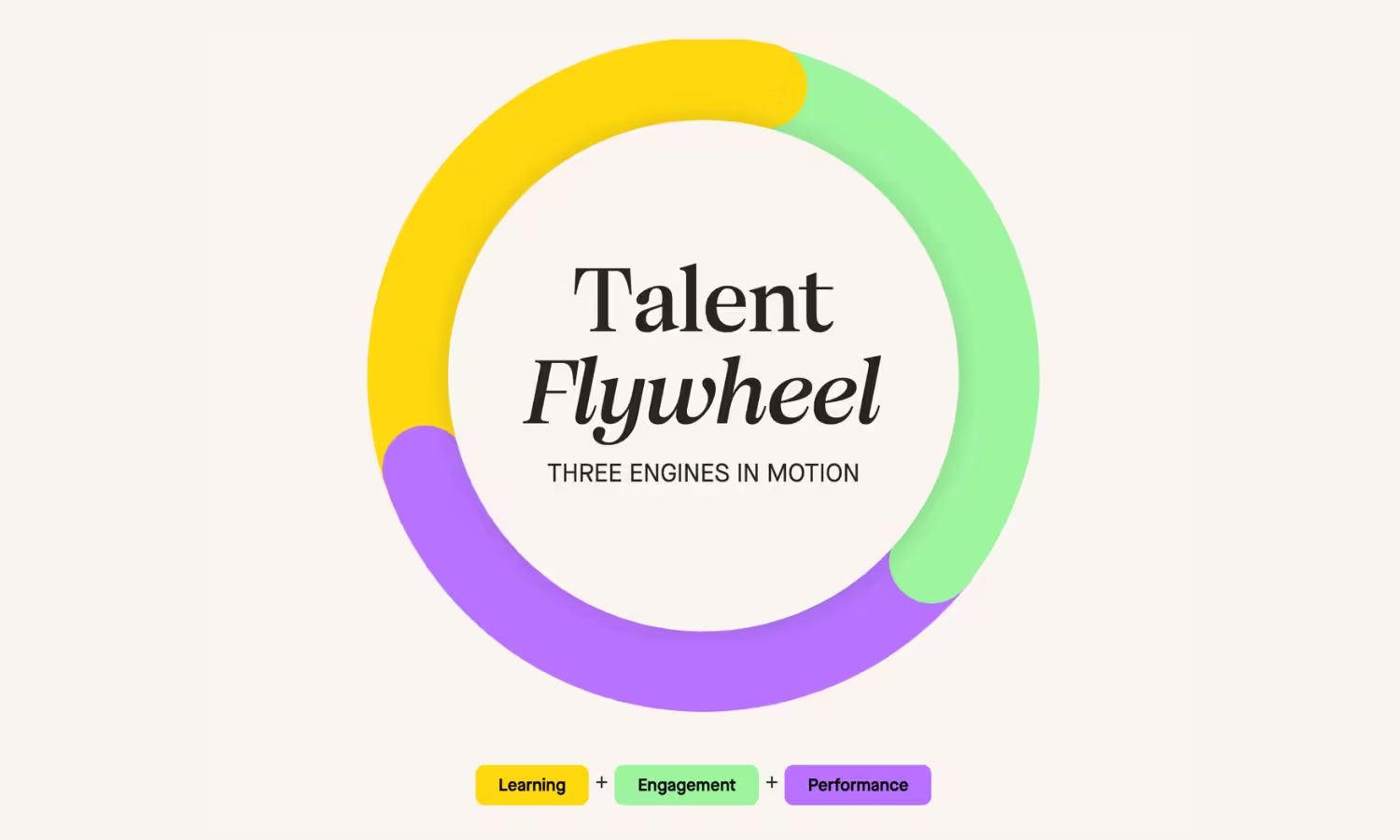
Put them together, though, and you’ve got a “talent flywheel”. Learning data shows you what to build and to send out – to whom, in which format, and when. Engagement data shows you where the need is, who your champions are, and where you should focus your efforts for maximum impact. Performance data tells you whether it worked. The learning responds, engagement shifts, performance moves. They all propel each other.
This isn’t new-age thinking. It’s what most of us wanted to do when we came into this job. We just never had the data infrastructure to make it anything more than aspirational.
Ok, ok – how do I actually do this on a Monday morning?
A few things that genuinely seem to work, for what it’s worth:
- If you’ve not already done so, immediately stop accepting “Just do some training” as a brief. Instead, treat every incoming request as a diagnostic conversation. What’s changed? What’s the observable performance gap? Is training even the right lever? Very often it isn’t – and saying so early is the single highest-leverage thing we can do.
- Connect the three sources of information – even imperfectly. Full integration across Learning Experience Platform (LXP), HRIS and performance tools is where we want to be, but most of us aren’t there yet. So, start with what you have. Pull the reports manually. Talk to your HR and operations colleagues about what signals they’re already capturing. Pilot on one team or one capability area where you can use data from the three streams manually, without too much difficulty. Imperfect insight beats no insight – and doing nothing is the one answer none of us get to give.
- Measure transfer, not reaction. The Learning Transfer Evaluation Model is a solid scaffold. The Kirkpatrick Level 1 “happy sheets” are comforting but not very useful on their own (this won’t be news to you).
- Design for reactivation, not completion. A course that finishes on Friday and isn’t reinforced is a course that’s forgotten by Tuesday. Plan the “after” – spaced learning, application tasks, manager check-ins, buddy observation – at the same time as the “now”.
- Meet learners where they are. Desk, on site, shop floor, warehouse, in the van. Same human, very different context. The platform has to follow them, not the other way around.

This is the territory we spend most of our time with customers right now – bringing together learning, engagement, and performance data into something a busy L&D team can actually act on, and pairing it with the content needed where training genuinely is the answer. It’s the harder end of the problem than “generate a course with AI”. It’s also the end that pays back.
So, let’s go!
Don’t ignore what’s out there. Use the tools.
Engage your leadership stakeholders with what can now be done when you join up solid workforce data with well-designed, personalised learning – and measure whether it actually changed anything. Bring your managers along. Go out. Talk to them. Be bold.
Where do I actually start?
Fair question. A few practical first moves, roughly in order:
- Audit what you already have. LMS records, any engagement or pulse-survey data, whatever your HR and operations colleagues are already tracking. Most teams are sitting on more than they think.
- Make allies of your HR Business Partners and your operations leaders. They have the performance and engagement data you need, and they have the same “prove-it-worked” pressure you do. Collaborate.
- Pick one team, one capability, or one real performance problem as your pilot. Small enough to triangulate the three streams by hand. Big enough that moving the needle actually matters to someone senior.
- Agree what “good” looks like before you measure anything. The observable behaviour change you’re trying to produce. Without that, any data you pull is just noise dressed up as insight.
- Use the AI tools you already have to spot patterns. Plug the messy reports in, see what correlates. You won’t get everything, and that’s fine. You’ll get more than you had.
And remember the bit that hasn’t changed: you are the expert and the decision-maker. AI just hands you the data and the engine to act on what you already know about your colleagues and what they need.
The heart and soul of this work still comes from you. It always has. The difference now is that you can actually prove how and where you make a difference to your organization’s success!
This is the work that moves the needle. It’s also the work that’s hard to do alone. If you’re ready to connect your learning, engagement, and performance data – and actually prove what worked – we can help.
Book a demo to get started, or just get in contact.