Introduction
\nTraditional top-down performance reviews are becoming obsolete. Organizations that rely solely on manager evaluations miss critical insights about employee performance, leadership capabilities, and workplace dynamics. This is where 360-degree feedback comes in. See how Confirm handles performance management.
\n360-degree feedback, also called 360 feedback or multi-rater feedback, is a comprehensive performance evaluation process where employees receive feedback from supervisors, peers, direct reports, and sometimes customers. It provides a complete view of how someone performs from multiple perspectives.
\nIn this guide, we'll explore what 360-degree feedback is, why it matters, how to implement it successfully, and best practices for getting real results.
\n\n
1. What Is 360-Degree Feedback?
\nDefinition and Core Concept
\n360-degree feedback is a structured feedback process that gathers performance evaluations from all angles around an employee. Rather than receiving feedback from just one source (typically their manager), employees receive input from:
\n- \n
- Managers - Direct supervisors who observe daily performance \n
- Peers - Colleagues at the same organizational level \n
- Direct reports - Team members or subordinates (for managers/leaders) \n
- Customers or external stakeholders - Clients or other departments who interact with the employee \n
- Self-evaluation - The employee's own assessment of their performance \n
The result is a 360-degree view, feedback from every direction, that creates a more complete picture of someone's strengths, weaknesses, and development areas.
\nHow It Works
\nA typical 360-degree feedback process follows this flow:
\n- \n
- Identification - Select the employee to be evaluated and identify raters \n
- Survey distribution - Send structured questionnaires to all selected raters \n
- Anonymous responses - Participants complete surveys (usually anonymously) \n
- Data compilation - Feedback is aggregated and organized \n
- Report generation - A comprehensive feedback report is created \n
- Feedback delivery - Results are shared with the employee \n
- Development planning - Employee creates an action plan based on insights \n
360 Feedback vs. Traditional Reviews
\n| Aspect | Traditional Review | 360-Degree Feedback | |--------|-------------------|-------------------| | Sources | Manager only | Multiple sources | | Perspective | Single viewpoint | Comprehensive view | | Blind spots | Likely | Minimized | | Development focus | Moderate | High | | Employee engagement | Lower | Higher | | Time investment | Lower | Higher |
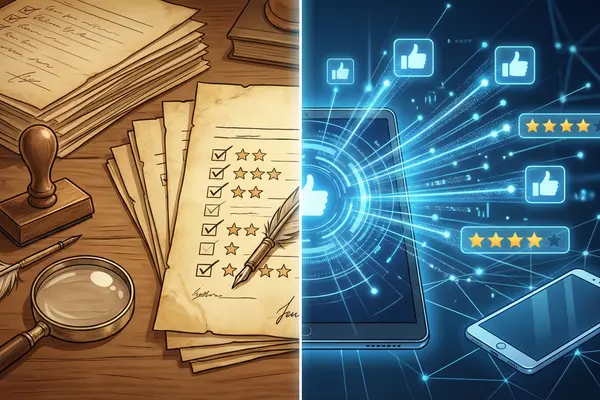
\nThe shift from traditional to 360-degree feedback represents a move toward more inclusive, development-focused performance management.
\n\n
2. Benefits of 360-Degree Feedback
\nBenefits for Employees
\nSelf-awareness and growth The most powerful benefit of 360-degree feedback is the self-awareness it creates. When employees see how others perceive them, especially when it differs from their self-perception, it opens the door to genuine development. A manager might think they communicate clearly, but feedback from direct reports might reveal they don't listen as well as they believe.
\nTargeted development With input from multiple sources, employees can identify specific areas for improvement and create focused development plans. Rather than generic feedback, they understand precisely which behaviors to change and who's noticing the impact.
\nReduced blind spots We all have blind spots, areas where our perception doesn't match reality. 360 feedback illuminates these gaps. A team member might not realize their pessimism is affecting team morale, or that their technical contributions are underappreciated by peers.
\nCareer clarity Comprehensive feedback helps employees understand how others perceive their readiness for advancement, potential, and fit for different roles. This is invaluable for career planning.
\nBenefits for Managers and Leaders
\nBetter leadership visibility Managers often only see how leaders perform in formal settings. 360 feedback reveals how they lead behind closed doors, do they actually listen to their teams? Do they follow through on commitments? Are they genuinely approachable?
\nImproved team dynamics When leaders receive feedback from direct reports, they often become more aware of their impact on team morale, engagement, and psychological safety. This can transform team culture.
\nSuccession planning insight 360-degree feedback data helps identify which high-potential employees are truly ready for the next level, not merely based on technical skills, but on interpersonal and leadership capabilities.
\nBenefits for Organizations
\nStronger culture and engagement Organizations that invest in comprehensive feedback systems create cultures of development and continuous improvement. Employees feel heard and see their organization investing in their growth.
\nReduced turnover When employees receive meaningful feedback and see a path for development, they're more likely to stay. The insight and attention signal that the organization values them.
\nBetter talent decisions 360-degree feedback provides richer data for promotion, assignment, and role decisions. You're not merely guessing at someone's potential based on one manager's opinion, you have comprehensive input.
\nAccelerated leadership development For emerging leaders, 360 feedback accelerates development by showing blind spots and providing specific behavioral coaching targets.
\nImproved performance and accountability When employees know they'll receive feedback from peers and direct reports (not merely their manager), accountability increases across the board. People are more conscious of how they impact others.
\n\n
3. How to Implement 360-Degree Feedback Effectively
\nStep 1: Define Clear Objectives
\nBefore launching 360-degree feedback, clarify your purpose:
\n- \n
- Development-focused - Is this primarily to help people grow? \n
- Evaluative - Will this inform compensation or promotion decisions? \n
- Mixed purpose - Both development and evaluation? \n
Best practice: Start with development-only feedback. Once people trust the process, you can incorporate evaluation.
\nDocument your objectives so raters understand why they're participating and what the feedback will be used for.
\nStep 2: Design Your Questionnaire
\nYour questionnaire is the foundation of your entire process. Poor questions yield poor data.
\nEssential elements:
\n- \n
- Clear competencies - Define 5-10 behavioral competencies relevant to the role (e.g., Communication, Leadership, Collaboration, Problem-solving, Accountability) \n
- Behaviorally specific questions - Avoid vague items. Instead of \"Is this person a good leader?\" ask \"Does this person clearly communicate expectations?\" \n
- Scale and open-ended - Use 5-point Likert scales for quantitative data, plus open-ended comment boxes for qualitative context \n
- Appropriate length - 10-20 questions maximum; respect people's time \n
- Role-specific versions - Different questions for managers vs. individual contributors \n
Example questions:
\n- \n
- \"This person clearly communicates goals and expectations\" \n
- \"I trust this person to follow through on commitments\" \n
- \"This person actively listens to and values others' perspectives\" \n
- \"This person handles conflict constructively\" \n
Step 3: Select Your Raters
\nNot everyone should rate everyone. Be strategic:
\n- \n
- Direct manager (required) \n
- 4-6 peers from different areas \n
- 1-2 customers/stakeholders (if applicable) \n
- Self-evaluation \n
For individual contributors:
\n- \n
- Their manager (required) \n
- 3-4 peers at similar level \n
- 5-8 direct reports \n
- Self-evaluation \n
For managers:
\n- \n
- Board member or CEO \n
- Peer executives \n
- 7-10 direct reports \n
- Key stakeholders \n
- Self-evaluation \n
For executives:
\nThe rater pool should be large enough to ensure anonymity while small enough to ensure each rater knows the person well enough to give valuable feedback.
\nStep 4: Ensure Anonymity and Psychological Safety
\nAnonymous feedback is essential. If people fear retaliation, they'll provide dishonest feedback.
\nProtective measures:
\n- \n
- Aggregated reporting - Never show individual rater responses; always aggregate (even if you have only 3 raters, show them as a group) \n
- Minimum rater threshold - Don't show individual scores unless at least 3 people provided that feedback \n
- Clear confidentiality statements - Communicate that feedback is confidential and won't be traced to individuals \n
- External administration - Consider using external vendors or Confirm's performance management platform to administer the process, creating an additional buffer \n
Step 5: Communicate Purpose and Process
\nBefore launching, communicate clearly with participants:
\n- \n
- Why are we doing this? - Is it development-focused or evaluative? \n
- How will the data be used? - Will it affect compensation, promotions, or just development? \n
- Who will see the results? - Usually just the employee and their manager \n
- What happens next? - How will employees act on the feedback? \n
- How is confidentiality protected? - Assure people their responses can't be traced to them \n
Clear communication increases participation rates and response quality.
\nStep 6: Deliver Feedback Thoughtfully
\nHow you deliver 360 feedback matters tremendously.
\nBest practices:
\n- \n
- Include a professional facilitator - A neutral third party (HR, external coach) should deliver feedback, especially if it's sensitive \n
- Frame it as development - Position feedback as a gift for growth, not judgment \n
- Start with quantitative data - Show aggregate scores and patterns \n
- Provide context - Explain what various scores mean \n
- Share verbatim comments - Include direct quotes from raters (anonymously) so the employee hears what people actually said \n
- Identify themes - Highlight consistent strengths and development areas \n
- Ask clarifying questions - Let the employee react and ask questions \n
- Create an action plan - Work together to identify 2-3 development priorities and concrete actions \n
Step 7: Follow Up on Development
\nThe real value of 360 feedback comes from what people do with it.
\nFollow-up activities:
\n- \n
- Check-ins - Manager follows up monthly on progress toward development goals \n
- Coaching - For significant development areas, provide professional coaching \n
- Peer accountability - Employee shares their development plan with a peer buddy for accountability \n
- Repeat cycle - Repeat the full 360 process annually or every 18 months to measure progress \n
Without follow-up, 360 feedback becomes a one-time event rather than a development catalyst.
\n\n
4. Common Pitfalls and How to Avoid Them
\nPitfall 1: Using 360 for Evaluation Before Trust Is Built
\nThe problem: If people suspect feedback will affect their compensation or job security, they'll provide dishonest feedback. They'll avoid giving critical feedback to peers they compete with, and they'll rate their managers highly to stay in favor.
\nSolution: Launch 360 feedback as a development tool only. Let it establish trust over 1-2 years before incorporating it into evaluative decisions. When you do make that shift, be transparent about it.
\nPitfall 2: Poor Question Design
\nThe problem: Vague, unclear, or irrelevant questions generate meaningless data. \"Is this person a team player?\" means different things to different people.
\nSolution: Work with HR and subject matter experts to design behaviorally specific questions. Pilot test your questionnaire with a sample group and revise based on feedback before full rollout.
\nPitfall 3: Selecting Inappropriate Raters
\nThe problem: If you have customers rate individual contributors who don't interact with them, or if you ask peers to rate on competencies only visible to managers, you'll get low-quality data and frustrated raters.
\nSolution: Be intentional about rater selection. Choose people who have direct observation of the relevant behaviors. Brief them on what they're being asked to assess.
\nPitfall 4: Insufficient Anonymity
\nThe problem: Small organizations, small teams, or transparent scoring can make it easy to guess who said what. This kills honesty.
\nSolution: Use aggregation thresholds (don't show individual scores unless 3+ people provided them). Administer through a third party when possible. Never share individual rater data.
\nPitfall 5: No Follow-Up Action
\nThe problem: Employees receive feedback, feel heard, then nothing changes. The organization moves on. People get cynical: \"We did the 360 thing, but nobody actually does anything with it.\"
\nSolution: Build follow-up into your process from the start. Managers are accountable for helping employees create and execute development plans based on feedback.
\nPitfall 6: Tone-Deaf Delivery
\nThe problem: Dumping a harsh feedback report on someone without context, facilitation, or support can feel punitive and demoralizing.
\nSolution: Use a trained facilitator to deliver feedback. Frame it as development. Give context. Allow questions and discussion. Offer support (coaching, resources) for significant development areas.
\nPitfall 7: Ignoring Negative Patterns for Leaders
\nThe problem: A manager receives feedback that they create psychological fear, but the organization doesn't intervene. Employees see nothing changes and trust erodes.
\nSolution: For leaders receiving concerning feedback, pair 360 feedback with required coaching or clear expectations for change. Don't let serious issues go unaddressed.
\n\n
5. Best Practices for 360-Degree Feedback Questionnaires
\nStructure and Design
\n- \n
- Aim for 10-20 questions maximum \n
- Focus on 5-10 key behavioral competencies \n
- Avoid redundancy \n
Keep it focused
\n- \n
- Instead of: \"Demonstrates leadership\" \n
- Use: \"Clearly communicates vision and goals to their team\" \n
Use clear, specific language
\n- \n
- Ask about strengths: \"This person excels at...\" \n
- Ask about development areas: \"An area for development could be...\" \n
- Ask about impact: \"How has this person positively impacted you?\" \n
Include both strengths and development areas
\nQuestion Types
\nLikert scale items (most common)
\n[1] Strongly Disagree\n[2] Disagree [3] Neutral [4] Agree [5] Strongly Agree
\n\"This person communicates clearly and ensures others understand expectations.\"
Open-ended prompts
\n\"What is this person's greatest strength?\"\n\"What is one area where this person could develop?\" \"What specific behaviors should this person start, stop, or continue?\"
Comparative questions (for certain scenarios)
\n\"Compared to others in similar roles, how would you rate this person's leadership?\"Tailoring Questions by Role
\n- \n
- Technical competence \n
- Collaboration and teamwork \n
- Communication \n
- Reliability and accountability \n
- Customer/client service \n
For individual contributors:
\n- \n
- Leadership and vision \n
- Developing others \n
- Emotional intelligence \n
- Decision-making \n
- Team engagement and culture \n
For managers:
\n- \n
- Strategic thinking \n
- Business acumen \n
- Board/stakeholder management \n
- Change leadership \n
- Integrity and values \n
For executives:
\nWhat to Avoid
\n- \n
- Negatively worded questions - Use positive framing (\"Communicates clearly\" not \"Doesn't communicate poorly\") \n
- Biased language - Avoid terms with gender, age, or cultural bias \n
- Ambiguity - \"Works well with others\" is too vague \n
- Overlapping questions - Each question should assess something unique \n
- Too many options - Stick to 5-point or 7-point scales; more creates analysis paralysis \n
\n
6. How Technology Improves 360-Degree Feedback
\nDigital Administration
\nModern HR technology platforms automate the entire 360 feedback process:
\n- \n
- Automated distribution - Send surveys to raters at scale \n
- Reminder systems - Automatic follow-ups for non-respondents \n
- Response tracking - Monitor completion rates in real-time \n
- Deadline management - Enforce response windows \n
Impact: Reduces administrative burden and increases completion rates from 40% to 80%+
\nReal-Time Analytics and Insights
\nAdvanced platforms provide:
\n- \n
- Aggregate scoring - Automatic calculation and visualization of average scores \n
- Comparative benchmarks - Compare results against role, department, or organizational baselines \n
- Trend analysis - Track changes over time across multiple feedback cycles \n
- Demographic analysis - Identify patterns across groups (which departments are highest in engagement, etc.) \n
Impact: Transforms raw data into actionable insights
\nAI-Powered Text Analysis
\nSophisticated platforms use AI to analyze open-ended comments:
\n- \n
- Theme extraction - Automatically identify common themes in qualitative feedback \n
- Sentiment analysis - Understand tone (positive, negative, neutral) \n
- Pattern recognition - Spot trends across large employee populations \n
- Red flag detection - Flag concerning patterns (e.g., multiple reports of poor listening from direct reports) \n
Impact: Makes it feasible to analyze feedback at scale without manually reading hundreds of comments
\nIntegration with Development Planning
\nThe best platforms connect feedback directly to development:
\n- \n
- Action plan templates - Guided prompts help employees create specific, measurable goals \n
- Learning recommendations - Suggest courses, coaching, or resources based on feedback \n
- Progress tracking - Monitor completion of development initiatives \n
- Manager dashboards - Give managers visibility into team development progress \n
Impact: Increases the likelihood that feedback leads to actual behavior change
\nCustomization and Flexibility
\nModern platforms allow:
\n- \n
- Custom questionnaires - Design surveys tailored to your organization and roles \n
- Multi-rater options - Different questions for managers, peers, direct reports \n
- Survey logic - Ask different follow-ups based on responses \n
- Branding - Maintain consistent look and feel with your organization \n
Impact: Makes 360 feedback fit your specific needs rather than forcing your process to fit generic templates
\nSecurity and Confidentiality
\nEnterprise platforms prioritize data protection:
\n- \n
- Encrypted transmission - All data encrypted in transit \n
- Secure servers - Data stored on secure, compliant infrastructure \n
- Access controls - Limit who can view results \n
- Audit trails - Track all data access for compliance \n
- GDPR/CCPA compliance - Meet privacy regulations \n
Impact: Protects employee privacy and organizational risk
\nExample: Confirm's Performance Management Platform
\nConfirm provides an integrated performance management system that includes:
\n- \n
- Customizable 360 feedback surveys - Tailored to your competency framework \n
- Anonymous, secure administration - Industry-leading confidentiality \n
- Advanced reporting and analytics - Aggregate insights and trend analysis \n
- AI-powered insights - Automatic theme and pattern detection \n
- Integration with development planning - Link feedback to growth initiatives \n
- Manager tools - Help managers effectively deliver and follow up on feedback \n
Learn more about Confirm's performance management capabilities
\n\n
7. Conclusion: Getting Real Value from 360-Degree Feedback
\n360-degree feedback is one of the most powerful tools for employee development, when done right. It provides the comprehensive, multi-perspective view that helps people see themselves as others see them and create meaningful development plans.
\nThe key to success is:
\n- \n
- Start with development focus - Build trust before using it for evaluation \n
- Design thoughtfully - Invest time in good questions and rater selection \n
- Protect anonymity - Create psychological safety so people give honest feedback \n
- Deliver carefully - Use skilled facilitators who frame feedback as development \n
- Follow up relentlessly - The work happens after the feedback is delivered \n
- Leverage technology - Use modern platforms to administer at scale and extract insights \n
- Build organizational capability - Train managers to receive feedback well and support development \n
When implemented well, 360-degree feedback transforms how organizations develop people, accelerates leadership growth, and creates cultures where feedback is seen as a gift rather than a threat.
\n\n
Ready to Transform Your Feedback Process?
\nIf you're looking to implement 360-degree feedback in your organization, Confirm's performance management platform makes it easier. From custom questionnaire design to AI-powered insights to integrated development planning, Confirm helps you get real results from your feedback initiatives.
\nOnce 360 data is collected, managers need to act on it. Our manager feedback examples guide provides 25+ copy-paste templates for turning 360 insights into actionable conversations.
Explore Confirm's Performance Management Solution or Schedule a demo to see how we can help you build a development-focused feedback culture.
If you're looking for calibration software to standardize ratings across your organization, see how Confirm approaches it.