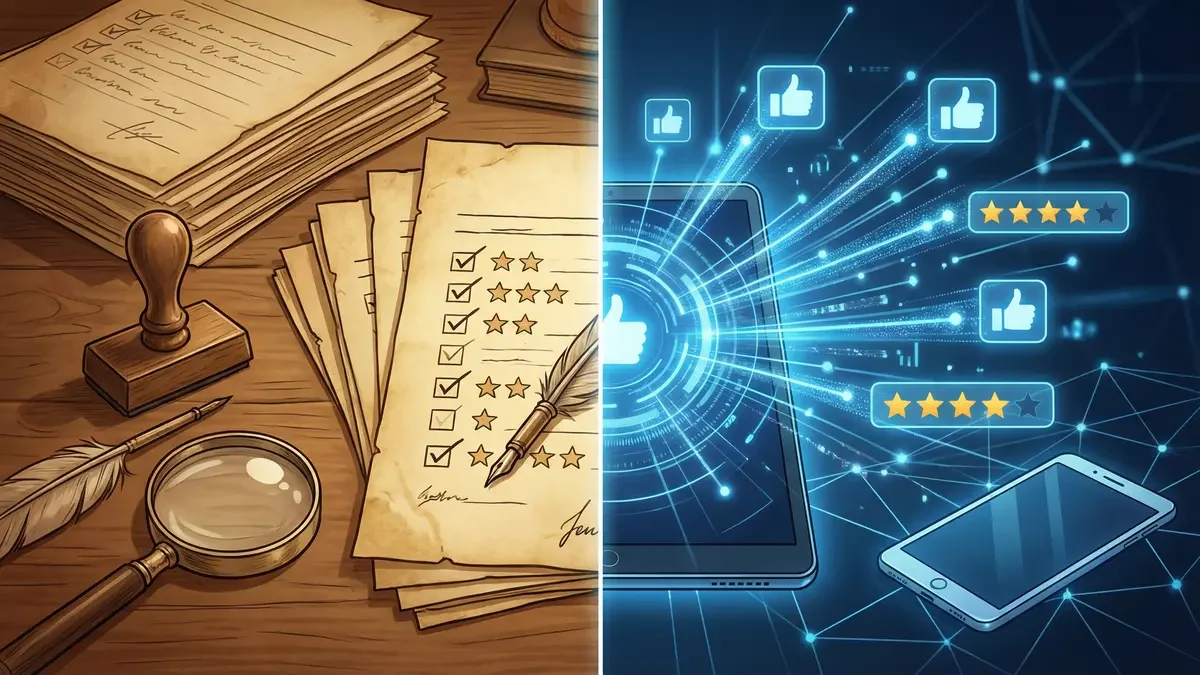
Here's what the research shows: traditional annual performance reviews make performance worse one-third of the time. They cost large organizations $2.4 million to $35 million per 10,000 employees. Only 5% of managers are satisfied with them. And 74% of employees say they're not useful. See how Confirm handles performance reviews.
Meanwhile, companies using AI-powered continuous performance management outperform their competition by 24%, attract top talent 39% more effectively, and retain that talent 44% better.
The question isn't whether AI performance management works better than traditional reviews. The data already answered that. The question is what's actually different, and whether your organization is ready to make the shift.
Quick Verdict: Which Should You Choose?
Choose traditional annual reviews if: - You're in a highly regulated industry requiring documented annual evaluations - Your compensation cycles are strictly annual with no flexibility - You have a stable workforce with minimal turnover and limited growth expectations - You need to maintain consistency with parent company processes
Choose AI performance management if: - You want to reduce bias and improve fairness in evaluations - You're losing talent due to outdated feedback cycles - Your managers struggle to remember employee accomplishments from 6+ months ago - You need real-time visibility into team performance and development needs - You're competing for talent in fast-moving industries
For most organizations in 2026, continuous AI-driven performance management isn't just better, it's becoming table stakes.
The Key Differences: Side-by-Side Comparison
| Factor | Traditional Annual Reviews | AI Performance Management |
|---|---|---|
| Feedback Frequency | Once or twice per year | Continuous, real-time |
| Data Source | Manager memory, end-of-year notes | Ongoing work data, multiple sources |
| Bias Risk | High (recency bias, personal bias) | Lower (data-driven, bias detection) |
| Time Investment | 210 hours/year per manager (avg) | 50-70% reduction in admin time |
| Employee Engagement | 2.7x lower vs. weekly feedback | 2.7x higher with regular feedback |
| Cost per 10K Employees | $2.4M - $35M annually | 40-60% lower operational cost |
| Manager Satisfaction | 5% satisfied | 60-75% satisfied |
| Accuracy | 50% of employees surprised by rating | Continuous calibration, fewer surprises |
| Development Focus | Backward-looking (past year) | Forward-looking (growth opportunities) |
| Talent Attraction | Baseline | 39% better at attracting top talent |
| Retention Impact | 87% of surprised employees less engaged | 44% better retention |
What Are Traditional Performance Reviews?
Traditional performance reviews are the annual (or semi-annual) evaluation process where managers assess employee performance, typically using a rating scale, and document accomplishments and areas for improvement over the past year.
How Traditional Reviews Work
The typical cycle looks like this:
- Preparation: Managers scramble to remember what employees did 8-12 months ago, often relying on scattered notes or recent memory
- Self-assessment: Employees write lengthy documents justifying their value
- Manager evaluation: Managers write formal reviews, calibrate ratings with peers
- Review meeting: The dreaded sit-down conversation where ratings are revealed
- Documentation: Everything goes into HR files
- Compensation decisions: Ratings drive raises and bonuses
- Filing: Reviews are filed away until next year
Managers spend an average of 210 hours per year on these activities. Employees spend about 40 hours each. For a company with 10,000 employees, that's over 1.8 million hours annually.
The Pain Points Everyone Knows (But Tolerates)
Recency bias is rampant. Managers remember the last 60 days vividly. Everything before that? Hazy at best. This means an employee who crushed it in Q1 and Q2 but had a rough Q4 often gets penalized, not because their overall performance was poor, but because memory is unreliable.
Research by Kluger and DeNisi found that traditional performance reviews make performance worse 33% of the time. Think about that. One-third of the time, the review process actually damages employee performance.
They're crushingly time-consuming. According to Deloitte, one organization calculated their review process consumed 1.8 million hours across the firm, hours that could have been spent on actual work, coaching, or development.
They're demotivating. 22% of employees have called in sick rather than face a performance review. 35% complained to peers afterward. 15% cried. These aren't numbers from a hostile workplace, these are averages across normal organizations.
They fail to recognize high performers. Two-thirds of performance management systems fail to properly identify and reward high performers, according to SHRM research. When your top talent isn't recognized, they leave.
The ratings surprise people, negatively. 50% of employees were surprised by their rating. Of those, 87% were negatively surprised. These employees showed a 23% drop in engagement afterward.
When Traditional Reviews Actually Work
There are scenarios where annual reviews still make sense:
- Heavily regulated industries (healthcare, finance, government) often require documented annual evaluations for compliance
- Union environments where collective bargaining agreements specify annual review cycles
- Extremely stable roles where job responsibilities don't change and performance is easily measured annually
- Organizations in crisis mode where implementing new systems isn't feasible
But for most companies? The costs outweigh the benefits.
What Is AI Performance Management?
AI performance management uses artificial intelligence to enable continuous feedback, data-driven insights, and ongoing development conversations throughout the year, replacing the annual review with a real-time, evidence-based approach.
How AI Performance Management Works
Instead of one annual conversation, AI performance management creates a continuous cycle:
- Ongoing data collection: The system tracks performance indicators, project completions, peer feedback, and development activities as they happen
- Real-time insights: AI analyzes patterns and surfaces trends, who's struggling, who's excelling, where skill gaps exist
- Continuous feedback: Managers give (and receive) feedback weekly or monthly, not annually
- Bias detection: AI flags potentially biased language in reviews and shows rating inconsistencies across teams
- Development focus: Instead of judging the past, conversations focus on growth opportunities and removing blockers
- Automated documentation: The system captures everything, so managers don't need to remember or reconstruct the year
- Smart prompts: AI reminds managers to check in, suggests conversation topics based on data, and drafts feedback templates
The Benefits That Actually Move Numbers
Continuous feedback drives engagement, measurably. Gallup found that employees who receive feedback weekly (versus annually) are 2.7 times more likely to be engaged. They're also 5.2 times more likely to agree they receive meaningful feedback.
Companies with continuous processes outperform competitors. Betterworks research shows that organizations adopting continuous performance feedback outperform competition at a 24% higher rate. They're 39% better at attracting top talent and 44% better at retaining it.
Bias gets flagged before it causes damage. AI tools can detect biased language in real time, words that signal gender bias, age bias, or recency bias. Mercer found that 60% of HR leaders say performance management doesn't work; bias is a major reason why. AI doesn't eliminate bias, but it makes it visible.
Managers save 50-70% of admin time. Instead of spending 210 hours per year on review activities, AI automates documentation, consolidates feedback, and generates draft reviews based on ongoing data. Managers spend time coaching, not filling out forms.
Fewer surprises, better conversations. When feedback happens continuously, year-end conversations aren't reveals, they're summaries. Employees know where they stand. This eliminates the negative surprise that tanks engagement.
How Confirm Approaches AI Performance Management
At Confirm, we built our platform around a simple principle: performance management should help people grow, not merelyify their salary once a year.
Our AI analyzes ongoing work patterns, flags potential issues early, and gives managers conversation prompts based on real data, not hunches or memory. When it's time for a development conversation, managers have evidence: specific projects, peer feedback, measurable outcomes.
The system detects bias in draft feedback and suggests more objective language. It reminds managers to check in before small issues become big problems. And it automates the documentation that used to consume hours every review cycle.
The result? Managers spend less time on paperwork and more time having conversations that actually improve performance.
Head-to-Head: Scenarios Where Each Approach Wins
Scenario 1: Fast-Growing Tech Startup (200 Employees, High Turnover Risk)
Traditional Review Performance: Managers conduct annual reviews in Q4. By January, 15% of employees have left, many citing lack of feedback and unclear growth paths. Reviews feel irrelevant because roles changed mid-year.
AI Performance Management Performance: Continuous check-ins keep employees matched with evolving priorities. Managers spot flight risks early through engagement data. Turnover drops by 30% in year one because people feel seen and supported.
Winner: AI Performance Management
Scenario 2: Regulated Healthcare Organization (5,000 Employees, Compliance-Driven)
Traditional Review Performance: Annual reviews satisfy regulatory requirements. Standardized forms ensure consistency across departments. HR has documented evidence for compliance audits.
AI Performance Management Performance: Continuous feedback improves day-to-day performance, but HR needs to layer in formal annual documentation for regulators. The hybrid approach adds complexity.
Winner: Traditional Reviews (with continuous feedback supplementing)
Scenario 3: Mid-Market Professional Services Firm (800 Employees, Project-Based Work)
Traditional Review Performance: Annual reviews happen in December, but employees worked on 12-15 different projects throughout the year. Managers can't remember details from projects that ended in March. Reviews are vague and demotivating.
AI Performance Management Performance: Project feedback is captured in real time. When December arrives, the system aggregates feedback from all project leads, giving a complete picture. Reviews are specific and evidence-based.
Winner: AI Performance Management
Scenario 4: Manufacturing Company with Stable Workforce (1,200 Employees, Low Turnover)
Traditional Review Performance: Roles are stable, job expectations don't change much year to year. Annual reviews work fine because performance is measurable (output, quality, safety metrics) and doesn't require nuanced feedback.
AI Performance Management Performance: The system provides some efficiency gains, but the ROI is smaller. Employees don't need frequent feedback because their work is routine and metrics are clear.
Winner: Toss-up (Traditional reviews work adequately; AI offers marginal improvement)
Implementation Realities: What It Actually Takes to Make the Shift
Switching from annual reviews to AI performance management isn't plug-and-play. Here's what organizations actually face:
Manager training is non-negotiable. Continuous feedback requires a different skill set. Managers need to learn how to give feedback in the moment, not once a year. Plan for 8-12 hours of training per manager in year one.
Compensation cycles need to decouple. If raises are tied to annual ratings, you need to rethink that. Many organizations keep annual compensation reviews but base them on continuous performance data rather than a single rating.
Culture shift takes 12-18 months. Employees who've experienced bad annual reviews may be skeptical. Early wins matter, celebrate managers who adopt continuous feedback well, and share their results.
Data governance gets complicated. Continuous systems generate more data. You need clear policies on data retention, access, and use. Who can see feedback? How long is it stored? What happens when someone leaves?
Budget reality: AI tools cost $15-30 per employee per month. A company with 500 employees might spend $90K-$180K annually. Compare that to the $1.2M-$17.5M cost of traditional reviews (using Gallup's estimates). ROI is clear, but budget approval still takes work.
FAQ: The Questions Leaders Actually Ask
Does AI performance management work for hourly workers or just salaried employees?
It works for both, but implementation looks different. For hourly workers in shift-based roles, continuous feedback often focuses on coaching and safety rather than goal achievement. The key is adapting the system to the work, not forcing hourly workers into a framework built for knowledge work.
What happens to employees who were "good" at gaming annual reviews?
They lose their advantage. AI systems track ongoing performance data, not merely the narrative employees craft in self-assessments. Some high performers who were poor self-promoters do better. Some who excelled at annual self-advocacy see their ratings drop to match actual output.
Can managers give negative feedback continuously without destroying morale?
Yes, when feedback is specific, timely, and paired with support. The research shows 72% of employees wish their managers would give more corrective feedback. The problem isn't negative feedback; it's vague, delayed, or unsupported criticism. AI systems help managers give feedback with context and actionable next steps.
How do you prevent "feedback fatigue" if managers are giving feedback constantly?
You don't give feedback constantly, you give it continuously, which means regularly but not excessively. Most effective cadences are weekly 15-minute check-ins or monthly 30-minute conversations, not daily critiques. AI systems help managers focus on high-impact moments, not nitpick every task.
What about bias in AI itself? Isn't that a risk?
Absolutely. AI tools can perpetuate bias if they're trained on biased data or designed poorly. The advantage is that AI bias is auditable and fixable, you can test the algorithm, adjust it, and measure improvement. Human bias is invisible and rarely acknowledged. The goal isn't perfect objectivity (impossible) but rather making bias visible so it can be addressed.
The Bottom Line: What the Data Actually Says
The research is unambiguous:
- Traditional annual reviews cost $2.4M-$35M per 10,000 employees and make performance worse 33% of the time
- Only 5% of managers and 10% of HR leaders find them effective
- 74% of employees say they're not useful
- Companies with continuous performance management outperform competitors by 24%
- Continuous feedback drives 2.7x higher engagement and 39% better talent attraction
- AI reduces manager admin time by 50-70% while improving feedback quality
For organizations still using annual reviews, the question isn't whether to change. It's how fast you can move.
The best performers in your industry are already using AI-driven continuous performance management. They're attracting the talent you want, retaining them longer, and developing them faster.
The annual review isn't just outdated, it's actively holding you back.
Ready to see what AI performance management looks like in practice? Book a demo to see how Confirm helps mid-market companies replace annual reviews with continuous, bias-aware performance conversations that actually improve results.
Related Resources: - Continuous Feedback Guide: How to Replace Annual Reviews - AI in Performance Management: Complete Implementation Guide - Continuous Feedback vs Annual Reviews: Research and Data - 9-Box Grid Guide: How to Use It With Continuous Performance Data
If you're looking for calibration software to standardize ratings across your organization, see how Confirm approaches it.