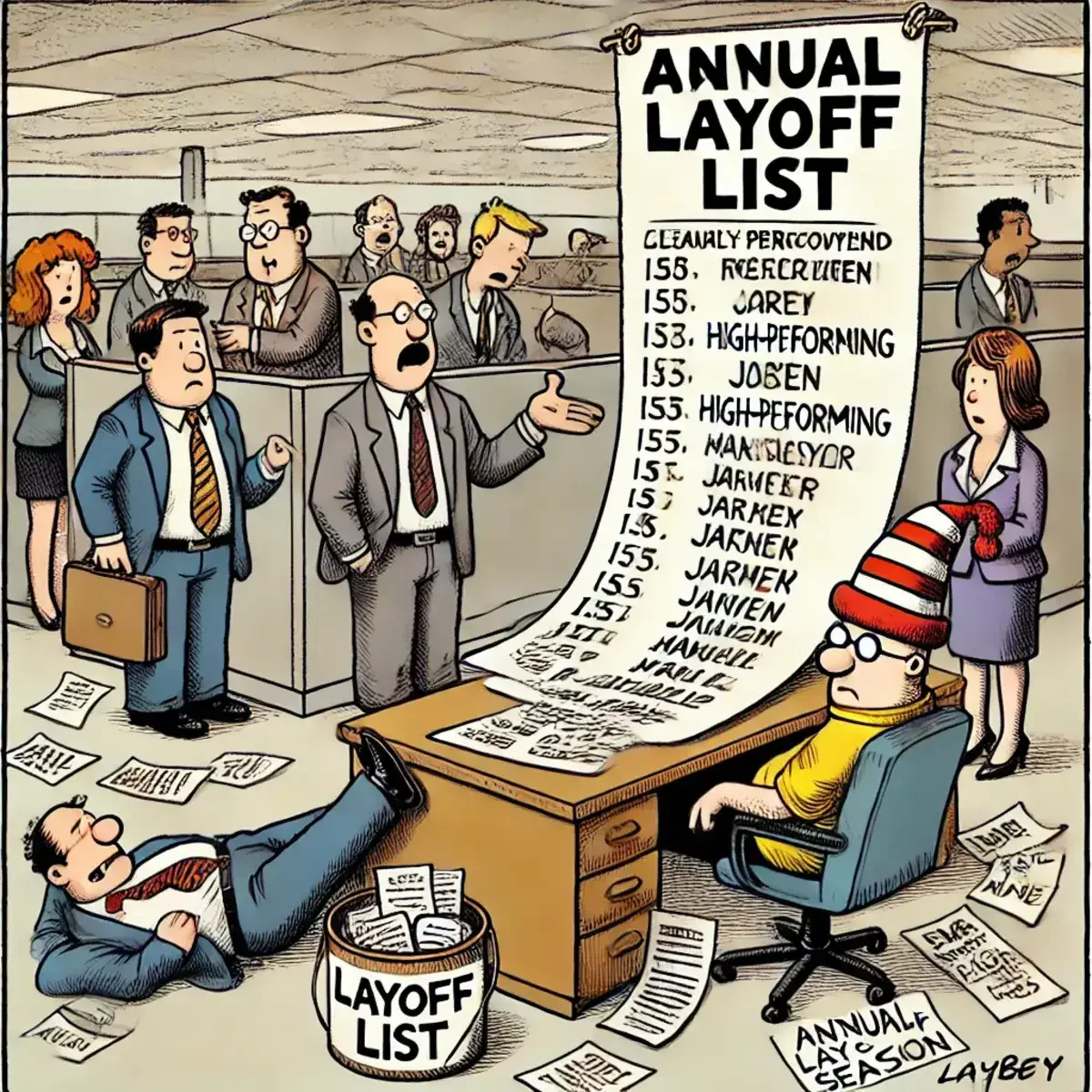
In the past few years, we've seen a troubling pattern repeat itself in the tech industry: rapid hiring, followed by mass layoffs. Just last week, yet another major company laid off more than 1,000 employees, and, as always, leaders framed it as a tough but necessary decision. See how Confirm handles performance reviews.
But was it?
What is traditional performance management?
Traditional performance management is an annual cycle of goal-setting, mid-year check-ins, and year-end performance ratings where managers evaluate employees against set criteria. It relies primarily on manager judgment, annual reviews, and forced distributions — tools designed for repetitive, individual work that no longer reflects how modern, collaborative teams operate.
The three most common failure modes:
- Subjectivity — Manager ratings reflect bias and relationships, not actual business impact.
- Recency bias — Annual reviews capture the last 60 days, not the full year of contribution.
- Invisibility — High performers who work quietly across teams get overlooked; self-promoters get rewarded.
What is traditional performance management?
Traditional performance management is an annual cycle of goal-setting, mid-year check-ins, and year-end performance ratings where managers evaluate employees against set criteria. It relies primarily on manager judgment, annual reviews, and forced distributions — tools designed for repetitive, individual work that no longer reflects how modern, collaborative teams operate.
The three most common failure modes of traditional performance management:
- Subjectivity: Manager ratings reflect bias and relationships, not actual business impact.
- Recency bias: Annual reviews capture the last 60 days, not the full year of contribution.
- Invisibility: High performers who work quietly across teams get overlooked; self-promoters get rewarded.
At Confirm, we believe these moments expose the deep flaws in how companies measure performance and make talent decisions. If layoffs are truly about cutting low performers, then why do so many companies struggle to explain who stays and who goes? The reality is that most organizations don’t have a data-driven way to measure employee impact, leaving them to rely on outdated methods like manager opinions or tenure-based cuts.
The Problem: Bad Performance Data Leads to Bad Decisions
Are we hiring the right people? Are we firing the right people?
Traditional performance management systems, whether it’s annual reviews, 360-degree feedback, or forced rankings, often fail to accurately assess who is truly driving impact within a company. These systems are subjective, inconsistent, and frequently biased. They also do a poor job of identifying the quiet high performers who make teams successful but may not be the loudest voices in the room.Layoffs are often a symptom of a larger issue: companies are flying blind when it comes to understanding real performance. Instead of waiting until it’s too late, organizations should leverage real data to understand who contributes the most long before a crisis forces them to make hasty decisions.
Recent layoffs at major corporations show these issues. JPMorgan Chase is laying off hundreds of employees, despite posting strong earnings, showing how disconnected performance management can be from real business needs (Yahoo Finance). Similarly, Chevron is planning to cut up to 20% of its workers as part of a cost-cutting strategy that fails to account for individual employee impact (Investing.com). Workday, a company known for its HR software, is also reducing its workforce, citing AI-driven efficiencies but providing little clarity on how those decisions were made (Fortune).
When layoffs come, leaders are left making decisions based on flawed or incomplete information. That’s why we so often see top talent getting cut while ineffective employees stay. It’s not because executives don’t care, it’s because they don’t have a reliable system for knowing who contributes the most.
The Solution: Performance Management That Actually Works
At Confirm, we see consistent evidence that leveraging Organizational Network Analysis (ONA) in performance reviews significantly increases the accuracy of identifying both hidden quiet contributors and problematic individuals that go unnoticed because they're great at managing up. Instead of relying on the opinions of a single manager, we use network-driven data to understand which employees are truly making an impact. Our platform surfaces the skills and behaviors that colleagues recognize in one another, providing a more accurate and unbiased view of performance.
By adopting a data-driven approach, companies can:
- Avoid bad layoff decisions by identifying high-impact employees before making cuts.
- Retain top talent and ensure that the right people are recognized and rewarded.
- Build a stronger culture where performance is measured by real contributions, by who talks the most in meetings.
The Bottom Line
Mass layoffs are a failure of business strategy; they’re a failure of performance management. Companies that rely on outdated systems will continue making costly mistakes, losing valuable employees, and damaging their reputations in the process.
The solution isn’t more layoffs, it’s a better way to understand who truly makes an impact. If you’re ready to stop guessing and start making informed talent decisions, it’s time to rethink performance management. It’s time to Confirm.
Want to see how Confirm handles this? Request a demo — we'll walk you through the platform in 30 minutes.
If you're looking for calibration software to standardize ratings across your organization, see how Confirm approaches it.