
Open three reports on a Monday morning. L&D says completions are up. Employee engagement data shows steady morale. Operations says one site keeps missing its numbers.
None of them can tell you why.
A workforce enablement strategy connects those signals so you can pinpoint the root cause and act immediately. Here is how to build one in five practical steps, adapt it for frontline and scale-up teams, and pilot it before scaling across your business.
What is a workforce enablement strategy?
Workforce enablement is about empowering your workforce to execute consistently, adapt quickly, and build confidence on shift – so you can drive revenue growth, reduce operating costs, and mitigate operational risk.
Connecting learning, engagement, and performance is how you get there. Together, these three signals form a continuous talent flywheel that turns daily worker capability into predictable business results.
An enablement strategy is the operational plan that makes this happen. It starts with what the business needs people to achieve, then ties what they learn, how deeply engaged they stay, and how they perform back to that one goal.
In practice, it comes down to five continuous operational habits executed in order.
Why one-signal strategies stall
Most organizations already run training courses, engagement surveys, and performance reviews. Each usually lives in a separate tool with a separate owner, so you see only a fraction of the picture.
When these three signals sit in separate tools, you end up with incomplete answers. Standalone learning tracks course completions without showing real business impact, leaving you asking “so what?” Isolated performance or engagement data highlights dropping metrics without giving managers a clear way to fix them, leaving you asking “now what?“
98%
of frontline leaders say their performance management and engagement initiatives improve frontline performance effectively, but only 46% say they do it very effectively (The Frontline Readiness Gap).

| Strategy built on | What it sees | What it misses | Leaves you with |
|---|---|---|---|
| Learning | Who completed training and when | Whether it changed worker confidence or shift performance | A “so what?” problem |
| Engagement | How people feel and where morale is slipping | Whether the cause is skills, management, or process friction | A “now what?” problem |
| Performance | Who is hitting targets and who is falling behind | Why the gap exists and what will close it | A “now what?” problem |
Research favors a connected approach. In fact, 39% of frontline leaders say a lack of integrated performance data directly holds back training effectiveness.
Visibility makes a massive difference. Leaders with a unified view of workforce capability are 3.5x more likely to achieve consistent performance during peak operational periods compared to those with partial visibility (The Frontline Readiness Gap).
Before you start: map where your signals live
Before setting a goal, spend an hour mapping where each signal lives today.
For most businesses, the answer is scattered. Training records sit in an LMS. Sentiment comes from an annual survey. Performance lives in review forms, spreadsheets, or inside a manager’s head.
For each signal, note three things:
- Where does it live?
- Who owns it?
- How often does anyone look at it?
The gaps tell you where to start. Bring all key owners together early:
- Frontline teams: Operations leaders, L&D, employee experience leads, and site managers.
- Scale-up organizations: Enablement leads, functional team heads, and People leads.
In his whitepaper on evolving HR roles, Confirm CEO Adam Thompson highlights why shared ownership matters:
“When the team wins, enablement wins.” Adam Thompson, CEO, Confirm.
The 5-step workforce enablement strategy
Each habit draws on all three signals. Skip one, and the strategy quietly stalls.
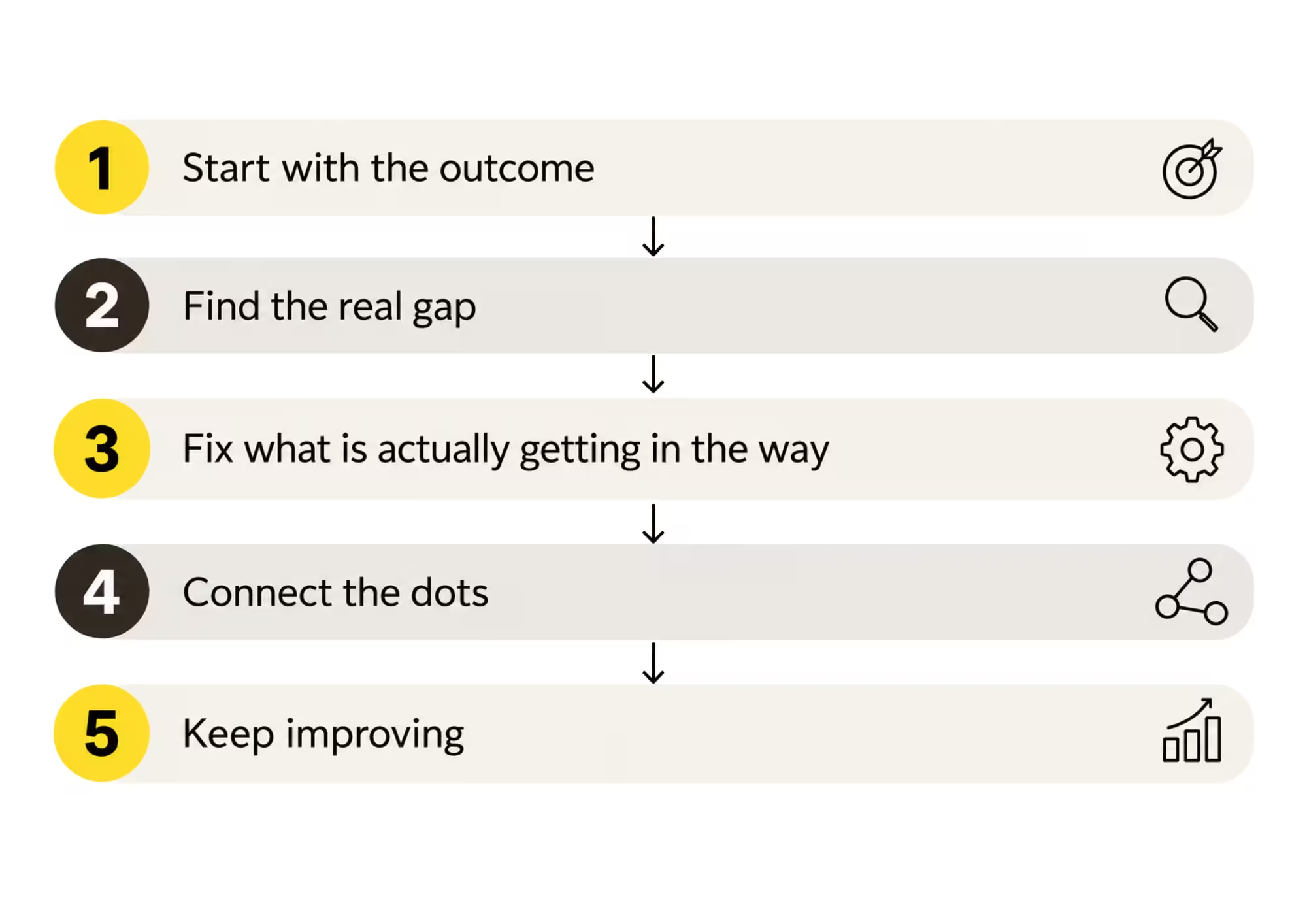
Step 1: Start with the outcome
Decide what the business needs to achieve, then identify where workforce performance is holding it back.
Pick a concrete operational metric the business already tracks:
- Time-to-productivity for new hires
- Execution consistency across stores, sites, or pods
- Early-tenure employee retention
- Ramp to quota or customer satisfaction scores
- Compliance risk and audit readiness
Choose one metric that leadership already watches. If the chief financial officer (CFO) tracks ramp time, focus on ramp time. Secure sponsorship from the owner of that metric – typically Operations for frontline teams or revenue leads in scale-up organizations.
Step 2: Find the real gap
Pinpoint where execution breaks down, then audit what your top performers do differently.
- Performance data shows where the execution gap exists down to the site or pod.
- Engagement data shows whether workers feel confident, stuck, or supported.
- Learning data shows what support has already been delivered.
Next, shadow your top 10% performing sites, stores, or reps. Observe their daily routines, wording, and workarounds.
Compare top performers against the rest across all three signals to isolate the exact gap.
Step 3: Fix what is actually getting in the way
When output drops, leaders often default to assigning more training. Pause and diagnose the true root cause first.
| Root cause | Which signal shows it | Operational response |
|---|---|---|
| Lack of knowledge | Learning and performance: errors cluster around task steps | Equip: Short guidance delivered at the work trigger |
| Low confidence | Engagement: sentiment dips on trained tasks | Equip and Act: Micro-practice and manager check-ins |
| Disengagement | Engagement: sentiment drops and early turnover spikes | Listen: Identify friction before changing content |
| Missing manager support | Performance and engagement: coaching lapses | Act: Reduce admin burden and send quick coaching nudges |
| Unclear expectations | Performance: execution varies wildly between sites | Act: Standardize top-performer baselines |
| Process friction | Performance and engagement: errors repeat at handovers | Fix: Adjust the operational process with floor leads |
Research shows that system complexity (46%), lack of manager support (46%), and time constraints (42%) are bigger barriers to performance than content relevance (The Frontline Readiness Gap). Most performance gaps require operational or manager support, not just more courses.
Step 4: Connect the dots
Take the root cause you isolated in Step 3, then run it through a continuous loop that closes it. This step is deliberately granular: you’re not applying these four actions to the business as a whole, but to the specific work trigger behind the root cause you just found. Four actions carry that loop:
- Equip: Deliver concise guidance directly at the work trigger behind that root cause.
- Listen: Capture real-time task confidence and sentiment on that same trigger.
- Act: Send supervisors 3-bullet coaching prompts based on recent shift data for that trigger.
- Measure: Track whether your Step 1 metric moves as a result of closing this specific gap.
Managers are the engine of this loop. Leaders who maintain effective coaching loops are 3x more likely to achieve consistent performance during peak periods.
Step 5: Keep improving
Enablement is an active routine. Establish a steady review cadence for each signal:
- Weekly: Review engagement and confidence signals to catch friction early.
- Monthly: Track performance metrics against your Step 1 target.
- Continuously: Refine support content based on floor feedback.
Once your first gap closes, return to Step 1 and tackle the next business priority.
Frontline vs. scale-up execution
While the five habits remain identical, execution adapts to your operating environment. Frontline teams fight time and distance; scale-up organizations fight rapid growth and context collapse.
| Step | Frontline teams | Scale-up organizations |
|---|---|---|
| 1. Start with the outcome | Time-to-productivity, store execution, audit readiness | Ramp-to-quota, early retention, messaging consistency |
| 2. Find the real gap | Compare top and bottom sites on shift output and confidence | Compare fast and slow rampers on confidence and onboarding milestones |
| 3. Fix what is in the way | System complexity, floor time, shared device access | Tribal knowledge, stretched managers, informal onboarding |
| 4. Connect the dots | Mobile guidance, shift pulse checks, floor coaching | Onboarding pathways, AI simulations, manager coaching |
| 5. Keep improving | Roll fixes across locations and track peak-period consistency | Update pathways as roles, products, and markets evolve |
Pilot first, then scale
Do not launch across the entire company at once. Select one store, region, or department struggling with your target metric.
Run the pilot through one complete review cycle. Document the before-and-after business impact to build a bulletproof business case for wider roll-out.
Scaling the strategy with a workforce enablement system (WES)
Manual tracking breaks down across multiple locations or hiring waves. That is where a workforce enablement system (WES) comes in.
A WES acts as the technology engine behind your strategy. While an ATS hires talent and an HRIS manages employee records, a WES keeps active workers capable, confident, and ready to perform every shift.
By automating the Talent Flywheel (Learn, Engage, Perform), a WES supports the flow of work, surfaces real-time sentiment, and automatically prompts manager coaching.
Next steps
Start by asking one simple question: Where is workforce unreadiness costing your business most today?
The answer sits in your data. Connecting your learning, engagement, and performance signals is how you fix it.
Book a demo to see how Confirm’s workforce enablement system brings this strategy to life, or dive into the complete guide to workforce enablement to explore the full framework.
Ready to turn your workforce enablement strategy into measurable action?