After several years of rapid experimentation, pilots, and technology adoption, Learning and Development (L&D) are now working with the outcomes. AI is no longer emerging; it’s embedded. Organizations are more skills focused, but they’re still struggling to adapt at speed. And employees on the front line are stretched, exhausted from constant change, and harder to engage.
This year’s State of Digital Learning Report explores what this moment means for L&D.
Our data
This research draws on data and insights from:
200+ L&D professionals in enterprise organizations
Over 600 learners in a corporate environment
28 learning experts and influencers
10+ industry research papers
Our findings
We’ve examined this year’s research and tracked how perspectives have shifted from previous years. Our findings focus on five key areas:
Current digital learning landscape
Explore the evolving challenges and opportunities L&D are facing as priorities, technologies, and constraints continue to shift.
Learner experience & expectation
Discover what enterprise learners expect from digital learning, and how closely provision matches those expectations.
L&D success stories
Hear how forward-thinking L&D teams are responding to change, overcoming barriers, and delivering measurable impact.
Digital learning trends for 2026
Uncover the key trends that L&D professionals and experts believe will shape digital learning in the year ahead.
Practical steps to stay ahead
Discover actionable ways to translate these trends into actions and strengthen your impact throughout 2026.
So, what might 2026 hold for your organization? Explore the report for peer perspectives, real-world examples, and expert guidance designed to help you move forward with confidence.
Chapter 1
Current digital learning landscape
From experimentation to strategic choices
Last year’s report saw L&D starting to move out of experimental modes. Teams had been testing new tools, exploring AI, and adapting to shifting skills demands. Agility and speed were the focus.
As we enter 2026, those experiments are giving way to consequences. Early decisions about platforms, AI use, and operating models are now shaping learning at scale. The challenge is no longer whether to change, but how to manage it while protecting learning quality, supporting people, and delivering real value.
With AI use accelerating, skills evolving at speed, and employees being more intentional about where they invest their time, L&D has reached a critical turning point.
So, what does this mean for digital learning professionals and experts?
What do your peers in L&D think?
We surveyed L&D leaders working in enterprise organizations across the world to explore what their digital learning landscape looks like.
What’s the current situation in L&D?
Against a backdrop of significant workplace disruption, there is little doubt about the importance of digital learning. An overwhelming 95% of L&D leaders say that digital learning remains a very important or critical part of their strategy for 2026.
But agreement on importance is not the same as confidence in delivery.
How well prepared do you feel?
Despite its strategic status, 87% of L&D professionals say they do not feel fully prepared to deliver impact in the year ahead. This figure remains unchanged from last year, signaling a persistent gap between ambition and capability.
Top priorities in 2026
While workplace learning is a must for organizational survival, the role L&D plays is in flux.
Two traditional priority areas remain:
45% want to improve quality and engagement
17% plan to increase capacity to scale up and respond quicker
But these figures have seen a significant drop compared to last year as new priorities have emerged:
15% will focus on personalization / adaptive learning
12% plan to increase learning in the flow of work
9% are exploring AI-assisted digital learning development
What challenges do L&D face?
L&D leaders are looking to prioritize the use of advanced technologies to create more adaptive, relevant, and supportive learning experiences, not just more content.
However, they face a number of obstacles to achieving these priorities.
What are the biggest challenges you face in achieving these priorities?
From budget constraints and skill gaps to tech limitations and resistance to change, many of L&D’s consistent challenges not only remain in 2026 but appear to be increasing. Add new concerns about ethical and legal use of AI and the data paints a picture of a function that’s feeling the strain.
This pressure is showing up not just in operational challenges, but in deeper concerns about the future of learning itself.
When asked what are their biggest concerns or worries about the future of digital learning, three core anxieties stood out.
1. Risk to learning integrity
Many L&D professionals worry that AI is being adopted faster than it is understood, governed, or used responsibly.
Speed, automation, and cost-saving are increasingly overshadowing evidence-based learning design, raising concerns that digital learning is shifting from capability development to content generation.
And this can result in learning experiences that are shallow, repetitive, or unverified.
Survey highlights
“That everything becomes automatically generated by AI and the quality takes a dive.”
“Overuse of AI is already reducing the quality of content.”
“Cookie-cutter AI content that starts becoming repetitive, and unverified information spreading.”
“AI is being seen as the god – it can help, but only if used strategically.”
2. Erosion of human-centered learning
Beyond quality, there are growing concerns about engagement, motivation, and connection.
Respondents describe learner apathy, attention fatigue, and surface-level participation, driven by too much content across too many platforms. Learning risks becoming something to skim or complete, rather than a meaningful support for growth. The loss of human connection, creativity, and social learning is particularly acute as employees face rising pressure
and disengagement.
Survey highlights
“Lack of human connection.”
“People are not engaged anymore by the amount of content they get every day.”
“Too much content, too many courses, which causes confusion.”
“Learning apathy among learners towards one way learning.”
“That it will not engage and is used as a tick box exercise.”
3. L&D’s future viability
There is also anxiety about L&D’s ongoing value and relevance. As organizations restructure and automate, L&D is still often perceived as a content factory – an increasingly vulnerable position in a world of automated content.
Capability gaps, inconsistent leadership support, and limited strategic clarity point to a function that recognizes the need to evolve, but does not always feel empowered to do so.
Survey highlights
“That my role will be replaced or massively reduced due to AI.”
“As employers see L&D as a content factory, the deeper use of AI will reduce the L&D workforce.”
“Increased pressure to produce more digital learning with limited budgets and resources.”
“The industry moves faster than my organization and we get lost.”
“Training is already a commonly dismissed and underrated skillset.”
What is and is not working?
To understand how these pressures play out in practice, we asked L&D professionals what they see working well and where digital learning is falling short.
Four elements were highlighted again and again as key to effective learning experiences.
Technology
Skills
L&D Capability
People
When technology is simple, accessible, well-integrated, and supportive at the moment of need, it enables learning to happen naturally. However, many organizations are still grappling with platforms that are hard to navigate, poorly integrated, or create outdated or ineffective content.
Rather than feeling enabled by technology, many learners experience it as another barrier.
Digital learning is most effective when it is skills-focused, role relevant, and immediately applicable. Microlearning, scenario-based approaches, simulations, and learning in the flow of work are highlighted as consistently outperforming generic, content-heavy courses.
Yet too much learning still falls into the trap of one-size-fitsall design. Where learning is disconnected from real work, behavior change rarely follows.
Strong digital learning experiences depend on robust design practice, clear standards, and close partnership with Subject Matter Experts (SMEs). Where L&D has the time, influence, and capability to apply people-centered design, quality improves.
Where it does not, familiar problems emerge.
Digital learning succeeds when it aligns with human reality: limited time, fragmented attention, and a desire for autonomy and connection. Blended approaches, peer learning, and supported self-directed learning are highlighted as consistently outperforming long, passive modules.
When learning fails, it is rarely because people don’t want to learn but because they are overwhelmed, unconvinced of relevance, or isolated in the experience.
Technology
Top 3 problems highlighted:
Poor learning platform integration and usability
Ineffective authoring tools
Complicated data analysis
Survey highlights:
“Our LMS platform is problematic.”
“Learning platforms with poor UX – hard to navigate, causing low completion rates.”
“Creating SCORM-based e-learnings that age as soon as they’re published.”
“Mobile learning – not all employees have access to a company mobile device.”
“Too many clicks for navigation and reporting.”
“We are having a difficult time with the data downloads… difficult to analyze.”
“Digitized but not redesigned – recorded lectures, PDFs, long videos.”
“AI generated videos… people see it everywhere and don’t pay attention.”
“Lack of features to support creation of true meaningful digital learning.”
“Integrating providers into one platform, reporting is a challenge.”
Skills
Top 3 problems highlighted:
Overly long learning experiences
Theoretical, recall-based experiences
Little opportunity for practice or application
Survey highlights:
“One-size-fits-all courses – not personalized, so learners tune out.”
“Sheep dip training.”
“Generic content.”
“Information dump.”
“Training that can be measured only on information recall.”
“Content is not adapted to different audiences and devices.”
“Too many terminologies, not easy to follow.”
“Courses are too broad or too long to be useful.”
“Learning without practical exercises doesn’t translate into behavior change.”
“Not connected to real work.”
L&D capability
Top 3 problems highlighted:
Slow development cycles
Over-reliance on vendors
Pressure to prioritize quantity over impact
Survey highlights:
“Lack of instructional design capacity.”
“Slow development time and review process.”
“Quantity over quality.”
“Over-reliance on vendors.”
“Following our vendors.”
“Limited governance and inconsistent quality standards.”
“Push for faster content development sacrifices quality.”
“Limited measurement of learning impact.”
“Lack of time to create and keep content current.”
People
Top 3 problems highlighted:
Limited time
Divided attention
Not feeling autonomy or connection
Survey highlights:
“Long, text-heavy elearning modules – low engagement and poor retention.”
“Click-through elearning.”
“People are not accessing the platform.”
“Engagement is a constant struggle.”
“Self-paced learning with no support – learners feel isolated.”
“Mandatory training feels irrelevant.”
“Offering a ton of courses has overwhelmed our associates.”
“Too much self-learning without human interaction.”
“Busy schedules, no time to learn.”
Across all responses, one theme is clear: digital learning works best when it removes friction and respects how people actually work and learn.
What do the experts think?
We invited L&D experts to reflect on the pressures and possibilities shaping digital learning today. Here are their thoughts on the current digital learning landscape and what it means for 2026.
1. Technology challenges
L&D teams are caught in the middle as organizations race to adopt AI faster than employees can adapt. Almost half employees surveyed by Leapsome said they feel pressure from leadership to implement AI in their workflows, but 38% say they cannot keep pace with leadership expectations.
Let’s see what the experts said about this widening gap between aspiration and capability.
“AI is transforming how ideas are formed and outputs created. It’s here to stay and needs to be embraced responsibly.” Aimee Young, Career Coach and Senior Leadership Development Consultant
“We’re stretching the rubber band of efficiency… and we’re going to discover we’ve gone too far. The rubber band will snap back…It’s less about content being automated and more about content being redefined… It’s about support in the moment when people are struggling and getting out of their way.” David Kelly, SVP of Strategy & Transformation, Bluewater
“The most exciting and the most terrifying [thing] is the way that technology is putting learning in the hands of the learner… which is the epitome of a learning culture, and it’s happening in the hands of our employees.” James Swift, Director of Talent Development, Leyton UK
“AI offers opportunities to do things differently – but we must use it with strategic purpose, not blanket application.” Jo Cook, Editor, Training Journal
“If we use AI to just create more content, worse content…that’s going to kill work-based learning.” Peter Manniche Riber, Senior Consultant, Implement Consulting Group
“If [using AI to generate content is] the limit of our imagination, we ought not to be allowed to have access to that technology…we’ve just seen the research suggesting that [content creation] is still the number one use case within L&D functions. That terrifies me.”
Robin Hoyle, Chair of World of Learning conference
2. Skills challenges
Leapsome’s research shows that as job requirements evolve rapidly, 1 in 3 employees doubt their skills would match what’s expected in a new role. At the same time, the World Economic Forum estimates that nearly 60% of the global workforce will need training by 2030 – placing growing pressure on L&D teams to help organizations keep pace with accelerating skill shifts.
“I don’t necessarily know if L&D – or anyone – is appreciating how fast the skills are going to change and how quickly this is going to move. This is like nothing we’ve ever seen before, and the agility for that is just going to be so extreme and so big.” Lori Niles-Hofmann, Founder, 8Levers
“We assume that if we put something in front of people, they’ll read it, they’ll get it, and then they’ll do it… [But] the knowledge to action gap is huge.” Amy Brann, Founder, Synaptic Potential
“We’re trying to move away from that one-size-fits-all approach to designing qualifications and trying to democratize our learning… to make it open and accessible to everybody and for everybody to get out of it what they want.”
Nick Baker, Senior Lead, Learning Design and Digital Innovation, The Football Association
“Technology creates opportunities for growth, not just learning. It demands a shift in L&D’s identity.” Laura Overton, Founder, Learning Changemakers
“For many, many years, I think [L&D has] faced this idea of being an order taker from the business…Skills get developed through experiences, exposure, and education being that smaller piece of it.” Neil Hunter, Chief Learning Officer, Deloitte Canada
“Does the learning and development department exist in five years’ time, or is it something else?…The transformation taking place [has L&D] broken down and put into a new way of approaching performance problems at work.” Donald H Taylor, Chairman, The Learning and Performance Institute
“L&D has to get that much closer to the business […] If we do not keep up with that, then I’m afraid we need to be rethinking our value and what we do.”
Avinash Chandarana, Chief Learning and Transformation Officer, mci group
“A lot of L&D people are now trying to keep up with the speed of all the AI developments. And I think they should focus on how people can cope with this fast-changing environment.” Geraldine Voost, Organizational Learning Strategist / Learning Business Partner, Nedap
“There’s a lot of focus on AI and technology at the moment, and how that can expand your capability as a team. However, the fundamentals of L&D don’t go away. You still need to be able to measure what’s working and what isn’t. You still need to create a culture of learning because that in itself creates innovation, safe spaces for people to fail hard and learn from those experiences.” James Swift, Director of Talent Development, Leyton UK
“L&D will not survive without giving the learners mental health, mental energy before the learning journey starts…Put people in a good place… Explain to people how they benefit.” Thimon de Jong, Keynote Speaker and Founder, Whetson
“I think it’s really easy for businesses to go, ‘Ah, we can drop a load of people and have technology doing this…We need our managers and our leaders to be driving human connection as well as just the business and the profitability of the business. If we don’t have that, we get less from an employee.”
Ad Davies, Managing Director, The Leadership Club
L&D is more critical than ever, yet more questioned. Learning is more accessible than ever, yet harder to engage with. Technology is more powerful than ever, yet capable of eroding trust, quality, and connection if misused.
How these tensions are navigated will shape not just digital learning strategies, but the future role of L&D itself.
So, how are these tensions showing up in the end user experience? Let’s find out what the learners think
Chapter 2
Learner experiences & expectations
As L&D teams push innovation – experimenting with AI, new delivery models, and new capabilities – employees are operating under sustained pressure. Workloads are heavy, change is constant, and access to AI-enabled tools now extends well beyond what L&D formally provides.
Learning matters more than ever, but it must compete with day-to-day work. In 2026, the challenge is not whether employees value learning, but where it fits, how it shows up, and whether it genuinely helps them keep pace.
76% of employees say they are more likely to stay with an organization that invests in their professional development.
What do modern enterprise learners want?
We surveyed employees in enterprise organizations to explore how they are engaging with learning in their global, corporate workplaces.
Here’s what we found.
Does you company’s investment in your professional development influence your decision to stay?
Learning remains a retention driver. But this year’s data makes one thing clear: what employees consider ‘meaningful’ learning is changing fast.
A typical workday still mostly involves individual or project work, but an increasing number of people are spending most of their time in meetings or with clients/customers.
Where does learning fit into the modern workday?
This constant disruption reshapes how learning can realistically happen. Short, interruption-proof moments matter are critical, but are they happening?
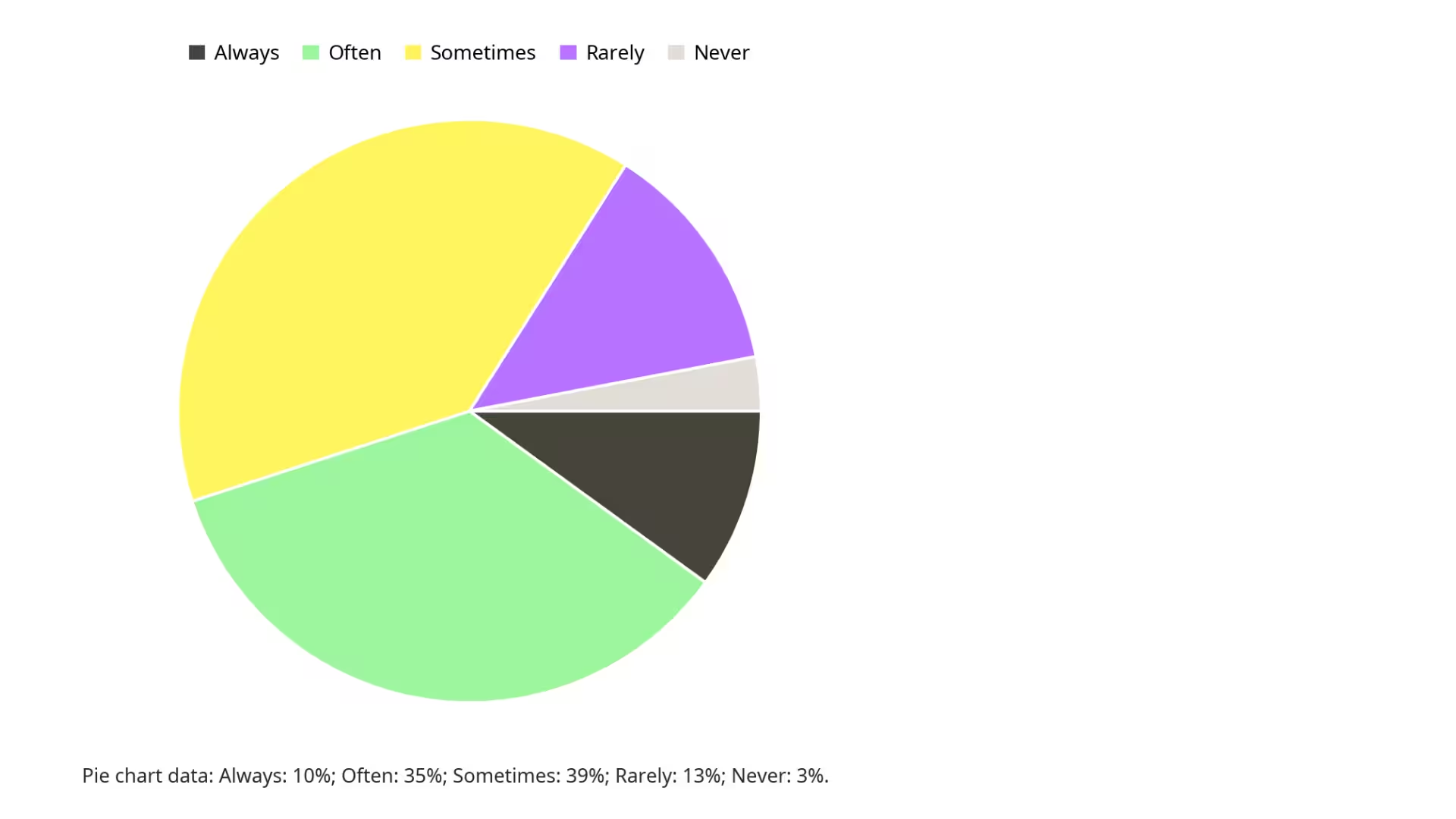
Frequency of engagement with digital learning continues to be more regular than in the past:
How frequently do you engage with digital learning provided by your organization?
Most digital learning still happens in the office or a designated workplace, accessed overwhelmingly on desktop devices.
Where do you usually complete digital learning provided by your organization?
For many learners, learning isn’t something squeezed into a commute or a quiet moment at home. It’s something negotiated within the working day, often under pressure.
What device do you prefer to access your digital learning materials on?
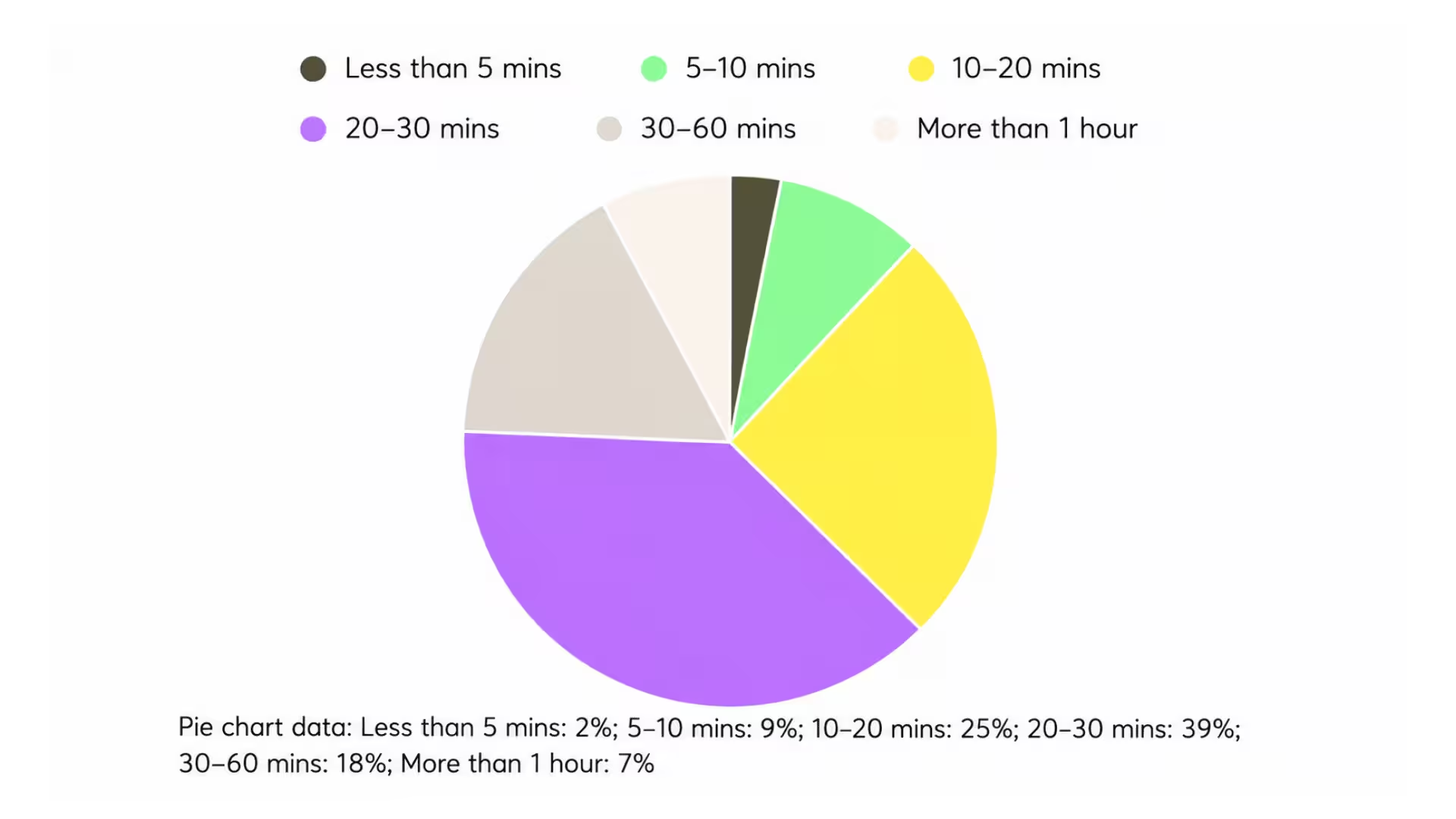
But a quarter of learning sessions still last 30 minutes or more.
These durations sit uneasily alongside stop-start workdays filled with meetings, notifications, and competing priorities.
How much time do you typically have to dedicate to a single learning session?
As work patterns continue to shift, the traditional learning session no longer maps to the modern workday. Flexibility matters. Employees need learning that respects their time, fitting around work and helping them do their job more effectively.
How does learning meet their needs?
Despite increased investment, many learners still feel a disconnect between learning and eaningful progress.
Around a third of employees feel that their digital learning does not align, or only partially aligns, with the company’s overall goals and objectives.
Do you feel that the digital learning courses provided by your organization align with the company’s overall goals and objectives?
While perceptions of learning being up to date have improved, three quarters of learners still feel it isn’t fully keeping pace with industry change.
Do you think your company’s digital learning approach keeps up with industry changes and innovations?
What do learners want from their digital learning experiences?
When employees talk about what they want from digital learning in 2026, the message is consistent: learning must help them solve real problems.
Relevance and quality
44% of learners want learning that can be relevant and personalized to their role.
Survey highlights
“Examples that relate to my job.”
“Real-world scenarios.”
“Applicable to my role.”
Yet only a small minority say their learning always feels relevant. For most, relevance is occasional or inconsistent.
Do you feel that the digital learning provided by your organization is personalized to your role?
24% of learners want quality learning experiences.
Survey highlights
“Interactive.”
“Hands-on exercises.”
“I like to do it as I’m learning.”
“I like watching a demo.”
Yet nearly half say digital learning quality hasn’t improved in the past year.
How would you describe the change in the quality of digital learning in your organization over the past year?
AI-produced learning isn’t solving this issue, and may even be increasing it with 41% rating it only adequate or poor.
How would you rate the quality of AI-produced learning (if you’ve experienced it)?
Ease and speed
25% of employees say it’s important that learning is easy to access.
Survey highlights
“Easy to use.”
“Seamless.”
“Quick to find information.”
And they’re finding it easier than ever to find online learning courses or resources.
How easily can you access digital learning materials related to your job?
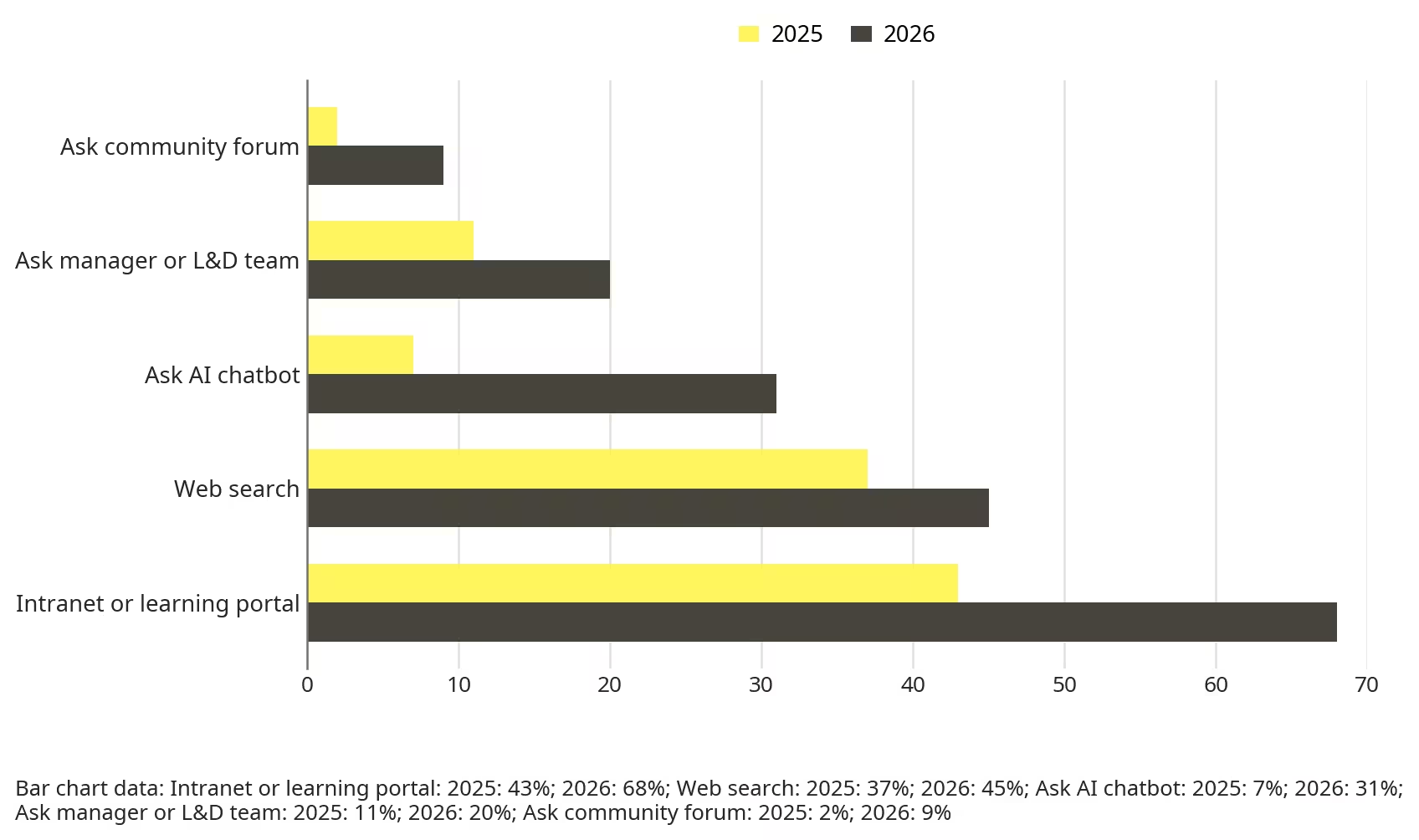
But ease alone isn’t enough. When faced with quick learning needs, employees go beyond the LMS.
When you have a quick learning need for work, where do you tend to find it?
There’s been a rapid adoption of AI chatbots to answer learning needs. And 62% of employees have used AI tools to support their learning in the past 6 months.
Have you used AI tools (like ChatGPT, Copilot, or other AI-based platforms) to support your learning in the last 6 months?
Learners are already exercising autonomy over how they learn, often using external tools where quality and consistency aren’t guaranteed. The challenge is not to stop this shift. It is to recognize it and put the conditions, culture, and guardrails in place to make autonomy safe, effective, and aligned.
“[There’s a] shift in the power balance between employer and employee. People will expect more autonomy in how they use technology and how they learn. Organizations will need to trust individuals more – to make their own calls on which tools to use, how to learn, and how to get their work done.”
Thimon de Jong, Keynote Speaker and Founder, Whetson
What is L&D doing to meet expectations?
Compared to last year, L&D’s response to learners’ changing expectations looks more structural and less experimental. Nearly three quarters of teams say their approach to digital learning changed significantly this year. This isn’t just about adding new platforms. It reflects shifts in workflows, skillsets, and partnerships.
So, where is this change happening and how does it meet learner and business needs in 2026?
The role of AI
AI is starting to become a normal part of L&D work, but the way teams use it is still in its early-stages.
Most teams have been experimenting or using AI in limited ways, with relatively few embedding it extensively across their work over the last year.
Which best describes your current use of AI in digital learning?
When asked how they see AI shaping digital learning, L&D overwhelmingly pointed to efficiency.
Survey highlights
“Focus on AI to speed up content creation and AI coaches.”
“AI coaches and building branching scenarios… as close to real life as we can get.”
“AI-generated content, experiences, process management, and impact analysis.”
“Using AI to develop content and create customized learning pathways.”
“There’s so much possible with AI – the challenge is integrating it into the standard way of working.”
How do you see AI shaping digital learning in your organization?
While advanced technologies are opening the door to more adaptive, relevant, and supportive learning experiences, AI use in L&D has so far centered on content delivery. AI is being adopted at speed, but capability (including digital literacy and governance) is developing far more slowly. Experimentation is high, but the overall strategic direction remains unclear.
Key opportunities to explore:
“Technology…is changing that mindset of how we traditionally learn and saying, how do I engage now with this technology, using agents for example, to make it far more dynamic, to what I need when I need it.” Avinash Chandarana, Chief Learning and Transformation Officer, mci group
“L&D leaders need to become fierce advocates for doing meaningful work, not just content creation…” Mark Sheppard, Diagnostic Learning & Development Lead, General Motors
“Take an upcoming project and try to do the right thing differently…For me [we need to use technology for] adaptive and personalized learning. This idea that you can offer learning that is aligned with the organizational goals but also with the individual needs. That’s what excites me. This increasingly embraces that one size does not fit all.”Jade Mountain, Director: Strategic Digital Learning Solutions, London Business School
“Use of AI, but use it in the bigger picture. Yes, it’s great for content development. Yes, it’s great for speeding up our processes, but also what can it help us do that we need to achieve for our organizations and our people.”Jo Cook, Editor, Training Journal
“Really mastering, if you can master, actually, the AI revolution, get more familiar, keep learning, be innovative, be a bit of a disruptor, don’t stay on the safe side, and just be creative and innovative. I think that’s the key, just to be a catalyst of that movement.”
Marina Mologni, Head of People & Culture, Atlas Copco Group
Common pitfall to avoid:
“It’s less about content being automated and more about content being redefined… support in the moment when people are struggling.” David Kelly, SVP of Strategy & Transformation, Bluewater
“Everybody can now create their own AI codes or create their own content… They don’t need L&D for that. And what frightens me is that a lot of L&D people are now trying to keep up with the speed of all the AI developments.” Geraldine Voost, Organizational Learning Strategist / Learning Business Partner, Nedap
L&D strategies for overcoming challenges
Rather than racing to automate everything, just under half of L&D professionals reference prioritizing governance, capability-building, and selective AI adoption.
There is a clear intent to slow down just enough to avoid losing credibility, relevance, or trust.
What this looks like in practice
Developing AI governance and ethics frameworks
Defining where AI adds value vs. where human judgment is essential
Upskilling L&D teams to manage AI tools, not just use them
Prioritizing quality and relevance over speed alone
Having clear strategic goals and outcomes in mind
Survey highlights:
“Building strong guidelines about the use of AI.”
“Continued focus on human voices, avoiding the temptation to sacrifice quality for perceived efficiency.”
“Pick the right AI tools.”
“L&D team upskilling, cautious introduction of AI.”
“We are developing AI governance and ethics framework.”
Skills gaps
Harnessing the right skills at the right time and for the right work is critical if employees and businesses are going to thrive. But L&D is being asked to close skills gaps at a time when organizational clarity about skills strategies is limited or ambiguous.
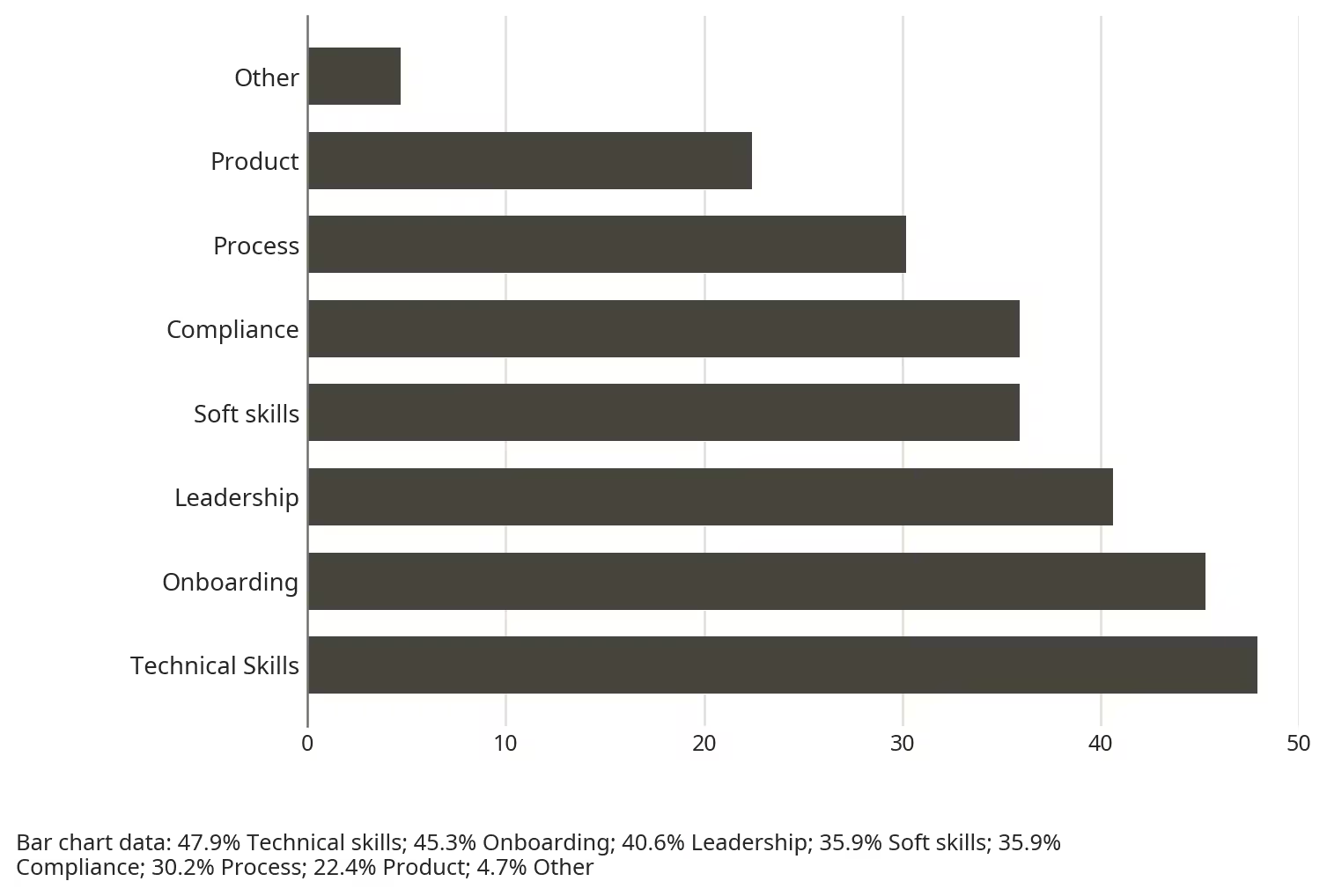
Technical skills, onboarding, leadership, and soft skills all compete for attention.
What training areas will be your biggest focus in 2026?
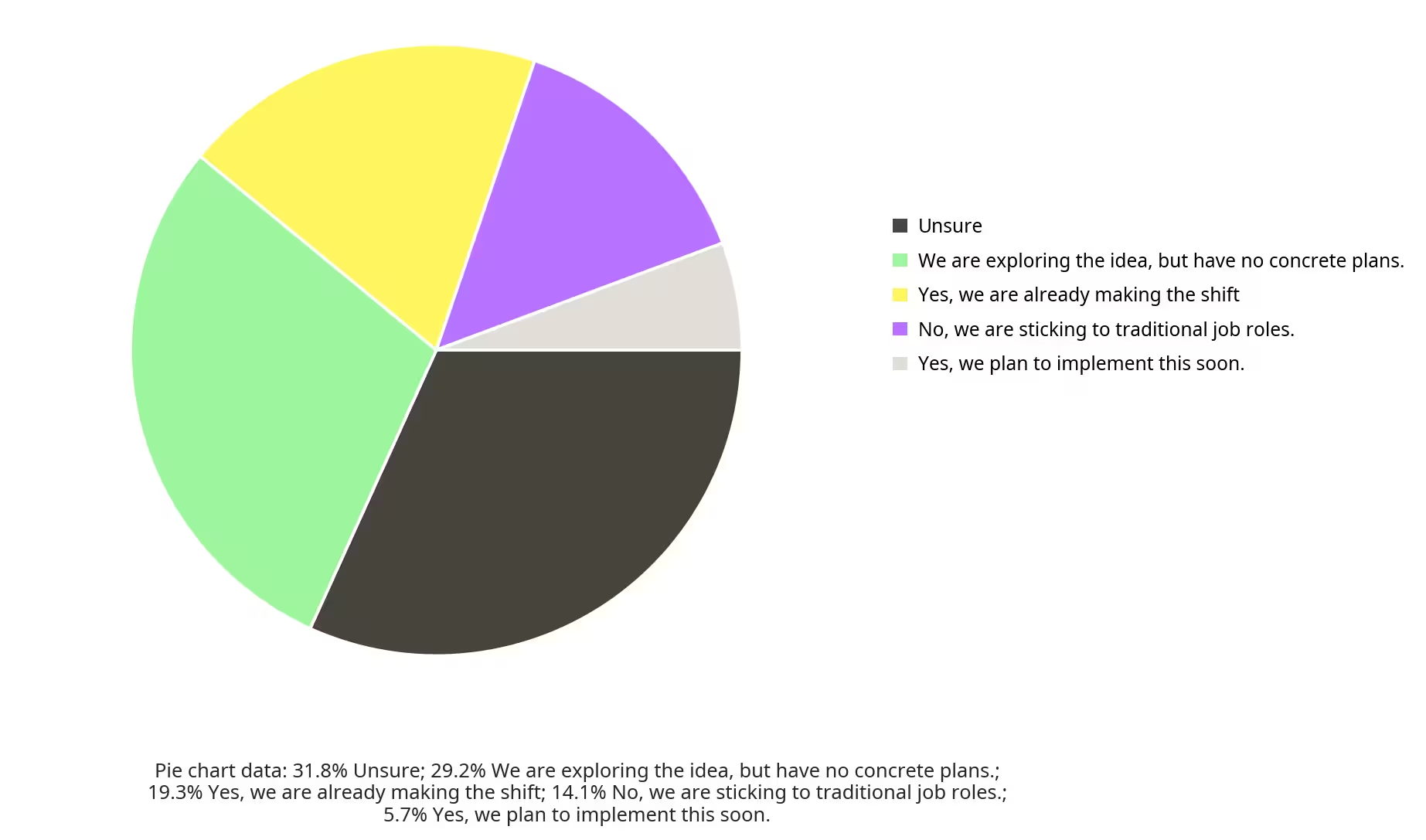
At the same time, many organizations remain unsure whether they are truly moving toward skills-based models.
Is your organization planning to shift from traditional job roles to a skills-based approach in the next few years?
This creates a familiar tension. L&D is expected to deliver skills for the future, while the business is still negotiating what that future looks like.
Key opportunities to explore:
“We need to move from just learning as a moment and it becomes more about enablement and focusing on the skills piece that’s going to drive performance because…without skills we don’t reach our business goals.” Penny Simpson, Senior Director of Global Enablement, Inriver
“I really do think that we should just focus so much more on demonstrating our impact… really roll out solutions that actually drive impact because to really drive impact it requires effort, and requires resources.”Melanie Martinelli, Founder, Go Beyond Training
“I really do think that we should just focus so much more on demonstrating our impact… really roll out solutions that actually drive impact because to really drive impact it requires effort, and requires resources.”
Melanie Martinelli, Founder, Go Beyond Training
Common pitfall to avoid:
“We’ve optimized for efficiency and content delivery, not for developing skills.” Neil Hunter, Chief Learning Officer, Deloitte Canada
“Skills in and of themselves are worthless. They don’t create value. They only create value when applied in the context of doing real work.”Sandra Loughlin, Chief Learning Scientist, EPAM Systems
L&D strategies for overcoming challenges
In the absence of clear, organization-wide skills strategies, many L&D teams are concentrating on strengthening their own capabilities and creating the conditions for skills to be applied in real work.
What this looks like in practice:
Continuous professional development for L&D teams
AI literacy and instructional design capability building
Supporting SMEs to create higher-quality digital learning
Shifting focus from completion to skill application
Survey highlights:
“Upskill L&D teams. Make best use of what we have.”
“We need to focus on a set of skills that will allow us to manage the AI tools and agents.”
“Give the team the skills.”
“Training/working alongside the workforce so they are able to create better content.”
“Create the roads for all instructional designers to hit the mark of business impact.”
The role of L&D
There is no settled blueprint for how L&D should be structured today. Instead, teams are navigating a period of change as demands on L&D continue to evolve.
L&D structures are in flux for many teams. No single operating model dominates.
How has your L&D team evolved in the last year?
Teams have explored hybrid structures, selective outsourcing, and varying degrees of SME involvement – often without consistent governance or enablement.
How would you describe the structure of L&D in your organization?
Do you currently outsource any part of your elearning content creation?
“I think more now than ever, that co-creation is important… giving the ownership to people within the business and not necessarily L&D or talent. Because they can then drive the changes.”
Teresa Rose, Director, ConsultHer Ltd
What percentage of digital learning projects are being created directly by SMEs?
The picture here is uncertain. L&D isn’t standing still, but it isn’t operating from a settled blueprint either.
Key opportunities to explore:
“[L&D] will have had to have reinvented themselves… reinvent the way that they deliver everything and reinvent the way that they think about learning.” Sarah Lindsell, Global Chief Learning Strategist, PwC
“L&D will survive by being much more integrated in the organization, stepping out of the L&D bubble, working in multifunctional teams, becoming involved in any change project.” Geraldine Voost, Organizational Learning Strategist / Learning Business Partner, Nedap
“You can’t make change happen unless you’re part of what’s going on there – tuning in to the business, the people, and the culture is vital.” Laura Overton, Founder, Learning Changemakers
“I think more now than ever, that co-creation is important… giving the ownership to people within the business and not necessarily L&D or talent. Because they can then drive the changes.” Teresa Rose, Director, ConsultHer Ltd
Common pitfall to avoid:
“Tunnel vision is a really good way to put it. You get stuck in this loop of, ‘We’ve always done it this way,’ and it becomes very hard to step outside that.” Mark Sheppard, Diagnostic Learning & Development Lead, General Motors
“Spending less time creating content when there’s so many tools that will do it for us… spend more time helping people change behaviors and implementing new practice.” Chris Baldwin, Performance Improvement Consultant
“We can’t keep pace anymore. So, clinging onto content and courses… no longer serves us well…It’s often our own thinking habits that get in our way – particularly feeling like we have to show up as the expert and provide answers and solutions.” Michelle Ockers, Chief Learning Strategist, Learning Uncut
L&D strategies for overcoming challenges
As organizations become more fluid, L&D teams are responding with agile, integrated, and strategic approaches. Rather than pursuing large-scale transformation, most focus on incremental, business-aligned changes. A third of respondents highlight leadership support, stakeholder engagement, and strategic alignment as essential, emphasizing focus, partnership, and influence over scale for its own sake.
What this looks like in practice
Securing C-suite sponsorship and shared ownership
Building business cases tied to outcomes and ROI
Embedding L&D into transformation and change initiatives
Prioritizing high-impact work and de-prioritizing low ROI activity
Survey highlights:
“C-level buy in and support.”
“To become a more strategic L&D partner.”
“Stay close to the business and highlight objective improvements.”
“Clear training roadmap aligned with key stakeholders.”
The focus on human connection
As pressure on wellbeing and engagement continues to rise, L&D is recentering learning around the human experience.
Perhaps the most telling shift this year is how success is measured.
Engagement, skill application, learner feedback, and business impact now matter far more than completion rates.
Which metrics matter most when measuring digital learning in your organization?
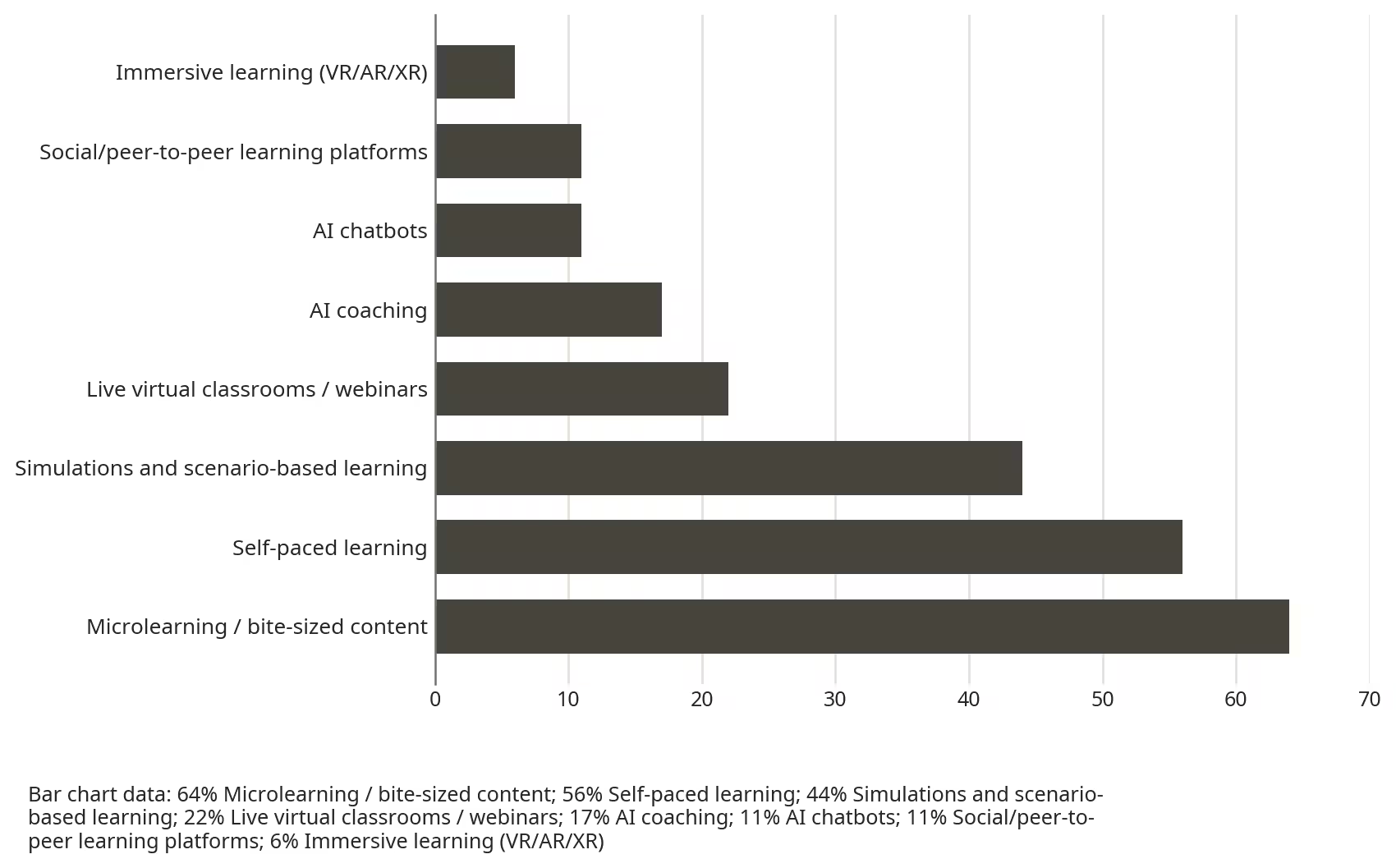
And the formats L&D plans to invest in reflect this shift: Microlearning, selfpaced learning, simulations, and scenario-based experiences, alongside selective use of AI coaching and chatbots.
At the same time, teams are deliberately preserving human connection through live sessions, peer learning, and communities of practice.
What digital learning formats are you planning to invest most in for 2026?
AI is seen as a way to accelerate and personalize learning, not to replace human interaction. Empathy, connection, emotional resonance, and psychological safety are being treated as design principles, not optional extras.
Key opportunities to explore:
“How do we create this low bar of access for people so they don’t have to go and find it? We show up in spaces and places where they’re already spending their attention and hopefully provide some value…If we can create a familiar, welcoming, inclusive environment and experience, then hopefully that puts people at ease and makes them more comfortable and more likely to come back.” Nick Baker, Senior Lead, Learning Design and Digital Innovation, The Football Association
“Create experiences that cause people to feel something and want to tell others about it.” Courtney Brouse, Talent & Development Manager at Midtown Athletic Clubs
“They need to double down on one thing, the mental health thing… put people in a good place. But the second one is, explain to people, especially your young learners, how they benefit today from a learning and development journey and not from a long-term perspective.” Thimon de Jong, Keynote Speaker and Founder, Whetson
“Developing the whole person means offering programs that feed passions – these spill over into growth mindset and divergent thinking.”Neil Hunter, Chief Learning Officer, Deloitte Canada
“The real opportunity here is for us to bring what is truly uniquely human to us – our empathy, our creativity, our problem solving abilities – into the solutions we’re building.”
David Kelly, SVP of Strategy & Transformation, Bluewater
Common pitfall to avoid:
“I do believe AI is taking away our ability and confidence to think critically… we need to bring human connection and psychology back in.” Aimee Young, Career Coach and Senior Leadership Development Consultant
“When there are moments of insight and you get a big dopamine hit, without that emotional resonance, you’re not getting it. If I’m talking to a bot, there’s no dopamine hit. There’s no joy. There’s nothing there.”Amy Brann, Founder, Synaptic Potential
L&D strategies for overcoming challenges
Around 30% of respondents highlight simplification, engagement, or humancentered design as key strategies. As AI speeds up content production, L&D is deliberately emphasizing human elements – connection, empathy, relevance, and psychological safety. Teams are focusing on bite-sized, blended learning to reduce cognitive overload and support wellbeing, treating human connection as a design principle, not a “nice to have.”
What this looks like in practice
Bite-sized, relevant, accessible learning
Blended models combining digital and human interaction
Communities of practice and peer learning
Clear “why” and immediate value for learners
Survey highlights:
“Reduce the text, make the content as intuitive as possible.”
“Keeping digital content bite-sized, relevant and accessible.”
“Helping teams see the‘why’ behind digital learning.”
“Human delivered meaningful learning centered around experience and application.”
“Launch communities of practice to engage learners in the design.”
Across all themes – technology, skills, structure, and wellbeing – L&D’s response to disruption converges on a common idea: invest in people, apply technology with intent, integrate more deeply with the business, and protect what is fundamentally human about learning.
In 2026, the learner experience is no longer defined by progress on platforms or completion of programs. It is defined by how well learning helps people keep up, feel supported, and do meaningful work in a world that rarely slows down.
Chapter 3
L&D success stories
Across this report, we’ve seen how learner expectations, work patterns, and technology are reshaping the learning landscape. To understand how these shifts translate into practice, we spoke to L&D teams who are already adapting their ways of working to deliver learning that is more agile, more human, and more closely aligned with business needs.
Here are three examples to get you inspired.
Customer Story
The FA: Creating open, accessible, learning at scale
The Football Association(FA) supports a national workforce responsible for player development across every level of the game, from first-time parent volunteers to elite professionals working in the Premier League. With over 170,000 affiliated coaches across England, the FA’s challenge is delivering learning that’s consistent, inclusive, and relevant across a hugely diverse audience.
Historically, football education has been qualification-led and heavily face-to-face.But the FA is shifting toward a more agile mode. They’re moving away from a one-size-fits-all approach and building learning that reflects the full game, including the women’s and girls’ game and Para football. This includes breaking qualifications into smaller, modular learning experiences, designed to be more flexible for learners balancing coaching with busy lives.
A core part of this strategy is creating a digital learning ecosystem that meets learners where they are. Social media channels – including TikTok, Instagram, and Facebook – play a key role, offering practical, bite-sized learning content in the platforms coaches already use. There are also pathways into deeper support through YouTube, online communities, and formal learning platforms.
“It’s not realistic to expect volunteers to log into another platform at nine o’clock at night… Can we provide them with learning materials on TikTok or Instagram, a tool in their pocket, where they might accidentally learn something?”
Nick Baker, Senior Lead, Learning Design and Digital Innovation, The Football Association
The results
Learning designed for 170,000+ coaches, from grassroots to the professional game
More accessible, modular pathways built around learner needs
A connected digital ecosystem that supports learning beyond formal courses
Customer Story
Benetton: Making every minute count for frontline
teams
For busy shop floor employees, time is always the biggest challenge. Benetton needed to support 4,000 learners worldwide across 14 language variations, but traditional training methods like long elearning modules or manuals weren’t built for the realities of frontline work. With limited attention and only short windows between customers, the question was simple: do you deliver generic content, or create meaningful learning moments that drive confidence, performance, and growth?
Benetton’s answer was a digital-first learning culture powered by Elucidat, designed around the end user. The team fully digitalized training and introduced “Learning Time,” giving every store employee at least 15 minutes per week dedicated to development. To make those moments impactful, they focused on engaging microlearning and a “test while learning” approach that helps staff build skills in small, practical steps and apply them immediately on the sales floor.
“We are most proud of the positive and detailed feedback received from store staff, confirming that both implemented and planned elearning courses and training programs effectively support their daily in-store activities.”
Irma Fumega Duarte, Global Retail Learning Manager, Benetton Group
The team also used Confirm’s flexibility to create interactive, brand-aligned learning that felt personal and relevant.
The results
Learning delivered to 4,000 employees across 14 language variations
3x increase in completion rates, rising from 20% to 60%
Improved performance, with stronger training engagement linked to higher sales outcomes in stores
Customer Story
National Trust: Making learning human, meaningful, and motivating
For the National Trust, Europe’s largest conservation charity, the challenge wasn’t just scale but engagement. With over 70,000 employees and
volunteers, the organization identified climate literacy as critical to achieving its net-zero goal by 2030, yet the complexity of the topic risked overwhelming learners.
Working with Elucidat’s Learning Consultancy team, the National Trust designed elearning that informed, reassured, and inspired. Clear learning
goals and an experience-led approach transformed a daunting subject into
something practical and meaningful.
Videos, polls, reflective questions, and internal case studies brought climate change to life and made it relevant across roles, teams, and locations – driving engagement at scale.
“It feels different. It feels very engaging. We’re trying to inspire people with it, which in an elearning platform is a real challenge…People love that it’s practical, clear, and engaging… and that’s resonated with everyone, no matter their role.”
Jenny Harwood, Organizational Development Manager
The results
Climate literacy embedded across the organization
High engagement across staff and volunteers
Learning positioned as a catalyst for cultural change
Chapter 4
Digital learning trends for 2026
As organizations navigate rapid AI adoption, shifting skills needs, and evolving learner expectations, L&D teams are entering a more decisive phase. In 2026, the focus is less on what’s possible and more on what works.
Here are the 10 corporate training trends our L&D experts expect to shape digital learning in the year ahead.
People and skills
Skills volatility and capabilities
2. The shift to skills-based organizations
3. Inclusive access to learning
Technology & infrastructure
4. Learning ecosystems over single solutions
5. AI as performance co-pilot
6. Learning in the flow of work
People
7. Data intelligence with ethics
8. Culture as multiplier of learning
9. From content creation to orchestration
10. Leadership as enabler of adaptability
Trend area #1: People and skills
Skills volatility continues to accelerate. As job requirements evolve faster than organizations can redesign roles, L&D is under growing pressure to build transferable, durable capabilities alongside technical expertise.
That pace of change is creating growing uncertainty for employees, many of whom are questioning whether their current skills will translate into future roles or new opportunities.
This is driving renewed momentum behind skills-based approaches that provide all employees with access to development opportunities and AI-enabled tools.
“If we are constantly dealing with things that are very surface level … then we’ve not made a case for why we wanted people in the room in the first place. In order to solve what problem? … If we don’t get that right, we have no right to exist within an organization.”
Robin Hoyle, Chair of World of Learning conference
In 2026, the value of L&D will increasingly be judged by its ability to develop real capability, not just deliver training.
Trend area #2: Technology and infrastructure
“These technologies can really fire up some of the ways that we want to do learning development – and are probably not that good at right now…Helping the business streamline and automate with technology should be our first and foremost goal.”
Peter Manniche Riber, Senior Consultant, Implement Consulting Group
Most organizations now operate complex learning ecosystems rather than single platforms. For L&D, integration and orchestration are becoming more important than adding new technology. They need to look beyond the horizons at the big picture and work to create seamless learning experiences for end users.
Within L&D’s tech stack one thing stands out. Just under three quarters of L&D professionals highlighted AI as the key trend shaping the future of digital learning.
Which trend do you see having the biggest impact on L&D?
L&D is looking to expand AI’s role. Moving from content generation toward performance support, with AI acting as a co-pilot that enables real-time guidance, practice, and personalized support in the flow of work.
The challenge for L&D is directing the use of this technology toward meaningful business outcomes.
In 2026, infrastructure decisions will increasingly need to reflect strategic intent, not experimentation for its own sake.
Trend area #3: Strategy and leadership
As learning data becomes richer, expectations are rising. The focus is shifting from tracking activity to generating insight, anticipating needs, guiding decisions, and supporting continuous adaptation.
But data alone doesn’t drive change. Culture remains a defining factor in whether learning translates into performance. Psychological safety, manager support, and permission to experiment consistently emerge as the strongest predictors of impact. When change becomes natural and instinctive as part of everyday work, Gartner finds that organizations are three times more likely to achieve healthy change adoption.
Together, the need for an effective learning culture and robust data analytics is reshaping L&D’s role. The emphasis is moving away from content creation and toward orchestration. That means connecting people, systems, and knowledge flows in ways that embed learning into the flow of work.
Leadership capability is critical to achieving this.
“Finding out what’s really important to your business…making that value really undeniable in what you can bring and what you can add.”
Sarah Lindsell, Global Chief Learning Strategist, PwC
Chapter 5
Practical steps to stay ahead in 2026
As AI accelerates, skills shift, and expectations rise, L&D is under pressure to demonstrate value in new ways. The strongest signals from 2026 show that impact won’t come from chasing tools or frameworks, but from combining human capability, intelligent technology use, clear strategy, and cultures that support learning.
So, what does this look like in practice? Based on expert insight and emerging patterns, here are five ways L&D teams can turn 2026’s trends into action.
5 ways these trends come together to deliver impact.
1. Use AI as a performance co-pilot, not a content machine
AI is rapidly becoming embedded across learning and work. But its greatest value doesn’t lie in producing more content. It lies in changing how problems are diagnosed, decisions are made, and performance is supported.
“A better question I would recommend anytime a new technology emerges is, how does this technology change what I do, or what can I do differently with this new technology that I’ve never been able to do before?” David Kelly, SVP of Strategy & Transformation, Bluewater
L&D teams need to use AI to augment thinking: surfacing patterns, analyzing language and feedback, and identifying emerging needs earlier – all while keeping humans focused on judgment and problem-solving.
How to get ahead:
Map where AI should augment learning workflows, not automate them
Use AI for diagnosis and insight, not just content generation
Define a clear AI use policy for L&D to avoid content overload
Shift team time from producing outputs to solving performance problems
2. Move from one-size-fits-all learning to adaptive, inclusive experiences
Learner expectations continue to fragment. Different roles, work patterns, and levels of access demand different forms of support. Generic solutions increasingly miss the mark.
“L&D teams need to double down on variety – offering learning in different ways, formats, and from different sources, moving away from one-size-fits-all approaches.”
Jade Mountain, Director: Strategic Digital Learning Solutions, London Business School
Personalization is now less about preference and more about relevance: tying learning to context, capability, and real challenges – particularly for groups that have historically been underserved.
How to get ahead:
Identify who is currently underserved in your learning ecosystem
Link personalization to skills, roles, and work context – not clicks
Explore adaptive pathways, AI agents, and in-flow nudges
Bring learning to where work already happens
3. Build L&D capabilities that match the pace of change
As expectations rise, L&D’s own skills are under the spotlight. Technical fluency matters – but it’s not enough on its own.
“The L&D teams best positioned for 2026 are strengthening their consulting mindset – diagnosing needs, influencing stakeholders, and understanding how the business truly operates.”Laura Overton, Founder, Learning Changemakers
How to get ahead:
Conduct a skills audit across your L&D function
Prioritize consulting, influencing, and diagnostic capability
Introduce learning sprints to build confidence with experimentation
Create internal communities of practice to share learning as you go
4. Turn data into strategic decisions (not dashboards)
Data is no longer the differentiator. Decision-making is. As AI and analytics become more accessible, L&D teams must move beyond reporting activity and toward using evidence to guide investment, reduce risk, and improve performance.
“I think they need to double down on getting their data sorted. Because if they are going to use any of the things I’ve talked about – around AI, around performance improvement, around understanding the roots of problems – they need to have evidence to support that investment of time and effort.”Robin Hoyle, Chair of World of Learning conference
How to get ahead:
Audit the data you already have across systems
Build lightweight skills signals before complex frameworks
Tie every metric to a clear decision or action
Partner with IT, people analytics, and operations for shared insight
5. Design learning systems grounded in human connection and culture
Technology may enable learning, but culture determines whether it sticks. Organizations that embed values and culture in employees’ day-to-day, supported by psychological safety and strong management, see a 34% increase in employee performance.
“Rather than developing more content that people probably won’t use, [we need to create] an environment that allows people to really learn and develop themselves… psychological safety, having managers really support the learning, and sharing what people have learned.”Geraldine Voost, Organizational Learning Strategist / Learning Business Partner, Nedap
This year, learning systems that blend digital pathways with human connection will be best placed to drive sustained change.
How to get ahead:
Design learning that strengthens cross-team understanding
Equip managers as coaches and learning connectors
Pair digital journeys with moments of reflection and facilitation
Measure cultural signals as indicators of learning impact
Following rapid experimentation, 2026 is shaping up to be a year of sharper focus. The opportunity for L&D is not to do more, but to do fewer things better: aligning learning to real needs, using technology with intent, and strengthening the human systems that make learning meaningful.
The question now isn’t what could you adopt next, but what are you ready to commit to in the year ahead?
Conclusion
Key takeaways for 2026 & beyond
The learning landscape continues to evolve, but 2026 marks a shift from experimentation to intent. After years of rapid change, the challenge for L&D is no longer adopting new tools or chasing trends, but making sharper choices. That means deciding where to focus, how to use technology purposefully, and how to build learning systems that genuinely support people and performance.
Across this report, one message stands out. The L&D teams best positioned for 2026 are those that combine human judgment, intelligent technology use, clear strategy, and cultures that enable learning to stick.
Three priorities emerge that will drive effective learning at an enterprise scale in the year ahead.
1. Design learning around performance, not production
AI is now a permanent feature of the learning landscape. But its value won’t be measured by how much content it produces.
In 2026, leading L&D teams will use AI as a performance co-pilot – supporting diagnosis, surfacing insight, and enabling learning in the flow of work. This means shifting time and energy away from content creation and toward understanding problems, shaping behavior, and improving outcomes.
Technology becomes most powerful when it amplifies human capability, rather than replacing it.
“Have a real understanding of what people are struggling with, whatchallenges they face in the day-to-day, and provide not content – provide stuff that really matters and helps them.” Nick Baker, Senior Lead, Learning Design and Digital Innovation, The Football Association
2. Build skills and capability in a more human, inclusive way
Skills volatility shows no sign of slowing. But addressing it isn’t just about frameworks or taxonomies.
The organizations making progress are focusing on transferable capabilities, inclusive access to learning, and experiences that reflect real work and real challenges. Personalization in 2026 is about relevance and context, not novelty.
At the same time, L&D’s own capability matters. Consulting skills, data fluency, ethical judgment, and the ability to influence across the business are becoming just as critical as design expertise.
”Focus on how people can cope with this fast-changing environment. So, teach them critical thinking, and teach them about bias and about ethics in using these technologies rather than trying to keep up with the technologies because it’s impossible.”Geraldine Voost, Organizational Learning Strategist / Learning Business Partner, Nedap
3. Strengthen the systems that make learning stick
Learning doesn’t happen in isolation. Culture, leadership, and everyday behavior are the real multipliers of impact.
In 2026, successful learning strategies will be those embedded into how organizations operate. They need to be supported by managers, reinforced by psychological safety, and informed by data that leads to decisions, not just dashboards.
The role of L&D is evolving from content provider to orchestrator: connecting people, systems, and knowledge in ways that support continuous adaptation.
“Pay attention to behavior change – understanding how to affect good behavior change, how to measure it, and how people are facing change. Being agile, flexible, and learning from mistakes is essential.”
Aimee Young, Career Coach and Senior Leadership Development Consultant
Put it into practice
This report was produced by Confirm. Confirm defines the future of workforce enablement – connecting the dots between learning, engagement, performance, and compliance to help organizations unlock the potential of every person on their team.
Learn more about Confirm and how you can create unique, personalized digital learning.