
You give your team training courses, track completions on a spreadsheet, and run annual performance reviews. Yet a new hire still takes months to get up to speed. Managers spend their shifts answering basic questions. Store or regional execution varies wildly from one site to another.
You do not have a learning problem. You have a workforce enablement problem.
This article breaks down what workforce enablement means, why the gap between training and readiness is growing, how to build an enablement practice in your organization, and where technology fits into the picture.
- What is workforce enablement?
- Why workforce enablement matters now: the enablement gap
- The business impact and ROI of workforce enablement
- Workforce enablement vs. related terms
- 5 core principles of an enablement-first culture
- Who owns workforce enablement inside the organization?
- How to implement workforce enablement
- 5 tactical best practices for workforce enablement
- Enablement in practice: frontline vs. scale-up
- Common enablement pitfalls to avoid
- How to measure if workforce enablement is working
- From practice to infrastructure: what is a workforce enablement system?
- Getting started with workforce enablement
What is workforce enablement?
Workforce enablement is the continuous practice of connecting learning, engagement, and performance so employees have the capability, confidence, and support required to execute their work.
An applicant tracking system (ATS) hires people. A human capital management (HCM) system or human resources information system (HRIS) administers them. Workforce enablement is what makes them capable, ready, and effective at the job.
Most traditional frameworks manage these areas in isolated silos:
- Learning and Development (L&D) assigns modules
- Employee engagement teams run annual surveys
- Operations managers track output
Because these activities rarely connect, leaders see disconnected metrics: high course completion rates alongside falling productivity or rising turnover.
Learning on its own leaves you with a “so what?” problem: training happened, but nobody can prove it changed anything. Engagement and performance on their own leave you with a “now what?” problem: the signal is there, but the next step isn’t.
As Confirm CEO Adam Thompson puts it: “Completions measure whether training happened. Margin measures whether it mattered.”
Workforce enablement connects these signals into a continuous operational loop called the Talent Flywheel:
- Learn: Content addresses a real operational capability gap and reaches people where they work, rather than being assigned as generic catalog courses.
- Engage: Real-time feedback, confidence scores, and sentiment data show where employees encounter friction on the floor or field.
- Perform: Performance data serves as the proof point, verifying whether learning and support actually translated into business results.
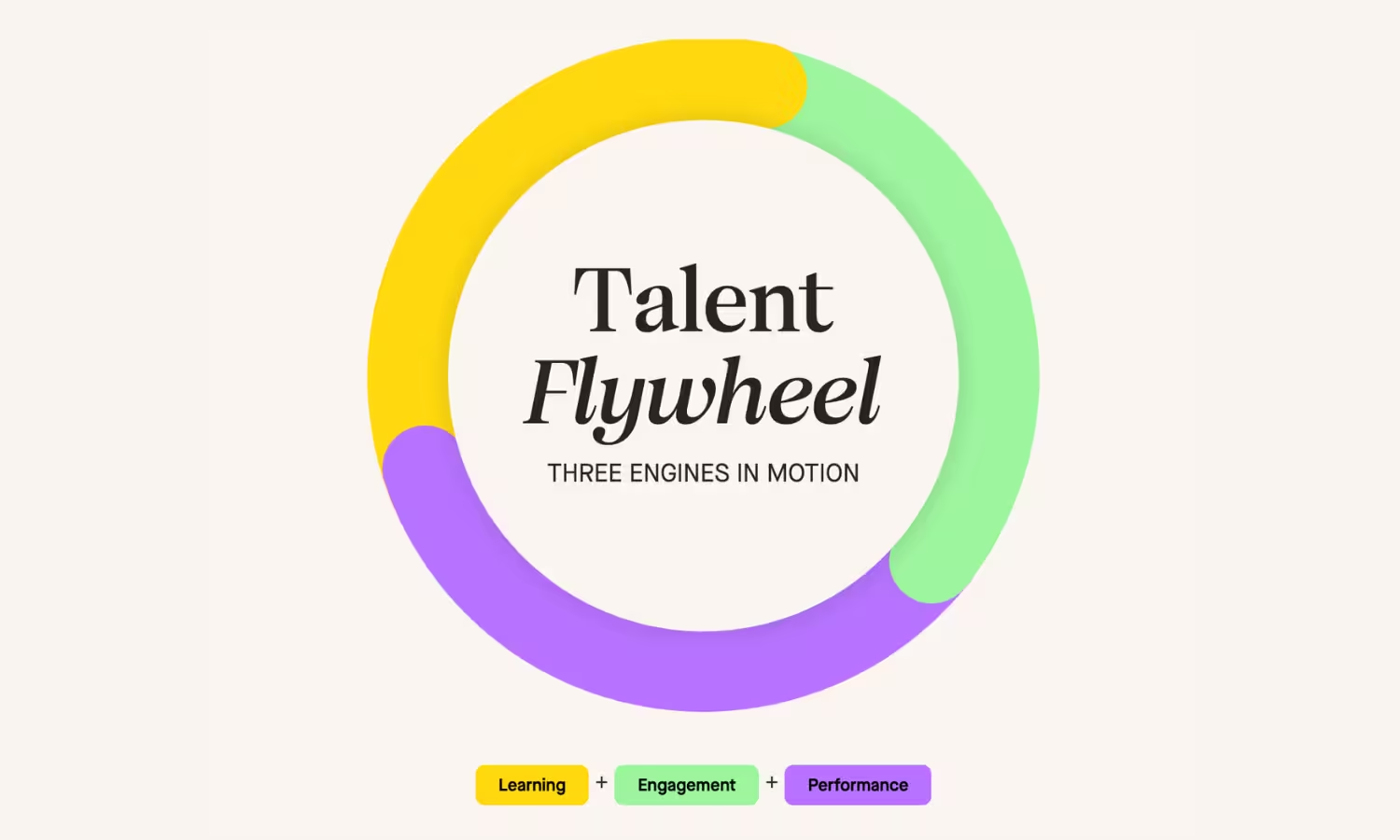
When these three signals work together, learning solves real problems, engagement data explains why performance changes, and performance metrics show where training should adapt next.
Why workforce enablement matters now: the enablement gap
Workforces are more distributed, shift-based, and fast-moving than ever. Legacy HR models designed for co-located teams sitting in one building can no longer keep up. When knowledge stays in spreadsheets or in a manager’s head, the gap between training and real readiness grows.
This mismatch creates the enablement gap: the operational distance between an organization’s growth goals and its workforce’s daily capability.
First-party research across enterprise operations highlights how acute this gap has become across two distinct operating environments.
For frontline operations
Frontline teams navigate shift rotations, high turnover, multi-site management, and strict compliance requirements. When onboarding and operational guidance are disconnected, productivity drops and risk spikes across locations.
76%
of frontline leaders say workforce readiness gaps create high operational risk across locations – rising to 90% in manufacturing. 72% report that new hires take more than four weeks to reach full productivity (92% in manufacturing).

(Source: The Frontline Enablement Gap)
You can read more here about the uncomfortable truth about frontline workforce enablement.
For scale-up organizations
Growing tech and business-to-business (B2B) organizations experience enablement friction caused by speed. As headcount climbs, informal context sharing breaks down, sales ramp times slip, and tribal knowledge fails to reach new hires.
93%
of scale-up leaders say organizational growth is outpacing employee enablement. 97% state that enablement challenges begin before reaching 1,000 employees, hitting hardest between 100 and 300 employees (43%) and 301 and 1,000 employees (52%).

(Source: The Scale-Up Enablement Gap)
Learn more about how growth exposes the scale-up workforce enablement gap here.
Whether you manage 50 retail locations or scale a distributed go-to-market team, traditional training leaves leaders guessing why performance varies. Workforce enablement closes that gap by treating capability as an everyday operational discipline.
The business impact and ROI of workforce enablement
Treating workforce enablement as an everyday practice delivers clear returns across four key operational areas. Recent benchmarking stats back this up, showing how performance moves when capability connects directly to business goals:
- Faster speed-to-competence: Sales teams proved this model first. Teams with formal enablement charters reach a 74% quota attainment rate versus 58% without one. They win 49% of forecast deals compared to 43% and ramp 47% faster. Applying this embedded model across other teams delivers similar gains.
- Higher execution consistency: Multi-site operations often suffer from wide performance gaps. In fact, 41% of frontline leaders report extreme variation between their best and worst sites. Organizations with full workforce visibility are over 3.5 times as likely to keep performance steady during peak periods (53%, compared to 15% for those with partial visibility).
- Higher early-tenure retention: More than a fifth of frontline leaders (21%) say over half of new hires miss target productivity. In scale-up teams, onboarding averages over two months, with 13% taking over three months. Removing daily friction keeps new hires confident and cuts early turnover.
- Proactive risk and compliance management: Training gaps frequently create compliance risks or operational failures, according to 76% of frontline leaders. Enablement tracks capability continuously, spotting exposures long before an audit flags them.
Workforce enablement vs. related terms
Workforce enablement is frequently confused with adjacent HR functions. While it builds upon these concepts, its scope and objective are distinct.
| Practice | Core focus | Primary metric | How it differs from workforce enablement |
|---|---|---|---|
| Workforce enablement | Connecting learning, engagement, and performance into one routine | Time-to-productivity, execution consistency, operational ROI | Unites all three signals into an ongoing system rather than managing them separately |
| Traditional L&D | Delivering courses and maintaining compliance records | Completion rates, module hours, test scores | Focuses on activity and content delivery rather than floor capability or performance output |
| Employee engagement | Measuring workforce sentiment, morale, and satisfaction | Net promoter scores, survey response rates, sentiment trends | Measures how employees feel; enablement connects sentiment to capability and work output |
| Performance management | Goal attainment, review ratings, feedback frequency | Goal attainment, review ratings, feedback frequency | Evaluates past performance; enablement provides the immediate support needed to improve future output |
| Workforce readiness | Assessing if employees are prepared for operational demands | Readiness scores, skill coverage, gap assessments | Provides a point-in-time snapshot of readiness; enablement is the ongoing practice that maintains it |
5 core principles of an enablement-first culture
Building an enablement-first culture does not require rewriting your entire operational model overnight. It requires shifting how leadership views training, support, and manager responsibilities.
These five principles outline the core operational habits that move your workforce from passive training to active performance.
- Lead with outcome, not activity. Stop celebrating 100% course completion rates if store productivity, sales output, or service quality remains flat. Track business outcomes, such as time-to-productivity, error reduction, and peak-period execution consistency.
- Bring support into the flow of work. 73% of frontline leaders say accessing training regularly disrupts core tasks – rising to 61% in manufacturing. Among organizations where training always disrupts work, 80% report frequent compliance failures, compared with just 6% where disruptions happen only sometimes. Deliver bite-sized guidance directly into daily workflows so employees find answers in seconds.
- Treat engagement as an early warning signal. A sudden drop in employee confidence or a rise in shift friction can predict operational errors weeks before quarterly performance data shows them. Use continuous sentiment listening to catch friction early.
- Empower the line manager. 46% of frontline leaders cite a lack of manager support and system complexity as their top enablement barriers. Administrative drag often traps shift supervisors and middle managers. Give them actionable, micro-coaching prompts so they can spend their time coaching teams on real floor gaps.
- Maintain a continuous loop. Ensure that every performance gap feeds directly back into targeted learning, and every engagement signal informs process improvements. Enablement is an ongoing operational routine, not a project with an end date.
Who owns workforce enablement inside the organization?
Enablement initiatives stumble when isolated within a single department. Traditional L&D tracks course completions – an activity that can climb while the business slides.
Traditional HR Business Partners (HRBPs) advise managers, but carry no scoreboard.
Workforce enablement fixes this by making capability a shared operational discipline across HR, Operations, L&D, and field managers.
While HR lays the foundational structure, modern enablement bridges the gap directly to Operations:
- Talent Acquisition (Buy): Brings in talent the organization does not have yet.
- HR Operations (Run): Manages payroll, benefits, compliance, and employee relations.
- HRIS (Platform): Serves as the data backbone every discipline plugs into.
- Workforce Enablement (Build): Gets more out of the talent you already own by giving them the daily capability and support needed to hit business goals.
For a deeper dive into why the traditional HRBP role is evolving and how this cross-functional model works in practice, read Adam Thompson’s whitepaper: The HRBP won’t survive the next decade.
How to implement workforce enablement
Once you align ownership across HR, Operations, and business leadership, the focus shifts from strategy to execution. Putting workforce enablement into practice follows a structured, five-step framework:
- Identify the specific operational bottleneck: Do not begin with a broad skills audit. Pinpoint where operational friction costs the business money today, such as long onboarding times, site quality variations, or high 60-day turnover.
- Study your top 10% performers: Audit your highest-performing location, store, or sales pod. Capture the unspoken routines, wording choices, and unofficial shortcuts they rely on daily to meet targets.
- Close gaps in the flow of work: Turn top-performer habits into short, targeted guidance. Deliver it right when workers need it, avoiding long classroom lectures.
- Connect sentiment to capability: Run brief pulse checks asking employees how confident they feel executing specific tasks. Use confidence dips to identify where you need additional support.
- Establish continuous manager coaching loops: Replace annual reviews with short, weekly coaching prompts for supervisors, focusing on one specific floor gap at a time.
The 15-minute enablement audit for leaders:
Ask your management team three simple questions:
-
- Which specific operational metric suffered most last quarter due to inconsistent execution?
- How long does a new hire take to handle a shift or call without asking a colleague for help?
- What single system tells you if last week’s training changed floor behavior today?
If you cannot answer question three, your organization is running isolated training, not workforce enablement.
5 tactical best practices for workforce enablement
While a step-by-step framework sets up your strategy, daily execution is where enablement succeeds or fails. Incorporating these five tactical habits embeds enablement directly into your workforce’s daily routines:
- Shift from “just-in-case” to “just-in-time” support
Stop loading weeks of upfront training onto new hires for scenarios they will not encounter for months. Structure support around key work triggers. Provide brief help exactly when it is needed, such as a 60-second safety refresher right before a complex shift. - Implement the 5-minute manager coaching loop
Line managers lack the time to build elaborate development plans. Provide supervisors with single-point coaching prompts based on recent shift data. Turning coaching into a quick, five-minute daily huddle helps managers address friction instantly without adding administrative overhead. - Codify peer knowledge from the floor
Centralized L&D teams often design courses in an operational vacuum. Capture real workarounds and practical advice directly from your top-performing frontline workers and field reps. Peer-sourced guidance is instantly credible and reflects daily working conditions. - Build sentiment-to-action triggers
Set operational thresholds for employee confidence scores. When pulse survey data shows lower confidence in a department or site, start an immediate manager check-in and add a micro-learning refresh within 48 hours to prevent operational errors. - Practice zero-downtime change enablement
When rolling out updated compliance standards, menu changes, software tools, or positioning updates, share them in small doses integrated into daily workflows. Keep operations running smoothly without pulling staff off the floor or pausing revenue activities.
These five core rules hold across any business. How you execute them comes down to your operating model – because running a shift-based floor looks very different from scaling a go-to-market team.
Enablement in practice: frontline vs. scale-up
Every workforce deals with friction, but where that friction sits depends entirely on how your business operates. A multi-site retail network faces completely different daily pressures than a scaling software company.
To make enablement work in the real world, you have to tailor delivery to the floor or field you are managing.
Frontline execution
- The challenge: Shift work, high volume, multi-site locations, low desk access, and strict compliance environments. Only 50% of frontline workers currently engage with training during shifts or on the job.
- The approach: Mobile-first, zero-disruption learning delivered in 30-second doses on shared devices or handheld tools.
- Key focus: Standardizing execution across all sites, reducing the time it takes new hires to get up to speed, and staying audit-ready and compliant – all without taking staff away from the floor.
Scale-up execution
- The challenge: Fast growth, distributed remote/hybrid teams, evolving product messaging, and outgrowing informal context.
- The approach: Structured onboarding pathways, AI conversation simulation, and role-based enablement replacing “just ask Sarah” tribal knowledge.
- Key focus: Closing the gap between compliance risk (which starts at about 475 employees on average) and formal performance infrastructure (which arrives at about 483 employees).
Whether you are protecting shop floor momentum or scaling a distributed go-to-market team, the goal is identical: deliver support right where the work happens. But even a tailored strategy can stall if you fall into predictable operational traps.
Common enablement pitfalls to avoid
Building an enablement practice is as much about what you stop doing as what you start. Even well-intentioned strategies get derailed when old administrative habits creep back in.
Recognizing these four common failure modes helps you protect your momentum before frustration sets in:
- Adding administrative drag: Over-formalizing processes by building a massive documentation library. 46% of frontline leaders report that system complexity actively hinders performance. Keep support lightweight and friction-free.
- Ignoring middle management: Not giving line supervisors enough time, visibility, or simple prompts to coach their teams well.
- Measuring activity over capability: Celebrating high module completion rates while ignoring whether store output, customer satisfaction, or productivity changed. Finished modules do not equal job readiness.
- Treating enablement as a one-off project: Treating enablement as an onboarding initiative with an end date rather than an ongoing operational routine.
Steering clear of these traps keeps your enablement practice grounded in real business value.
How to measure if workforce enablement is working
If you measure enablement with traditional L&D metrics, you are tracking activity, not impact. Course completions tell you training happened. They do not tell you if anyone is ready to perform.
Workforce enablement measures capability on the floor, speed-to-output, and execution quality. Focus on these five operational indicators:
- Time-to-productivity: Measure the exact number of days a new employee needs to reach full output compared to past baselines.
- Peak-period execution consistency: Track whether performance metrics stay steady across all locations during peak seasons or fast growth. 72% of leaders with very effective performance management report steady peak performance, compared with 23% of leaders with somewhat effective initiatives.
- Early tenure retention and confidence trends: Track 30-, 60-, and 90-day turnover alongside pulse confidence scores to spot retention risks early.
- Audit and compliance readiness: Check how quickly leaders can confirm workforce compliance and skills at every site before an audit occurs.
- Manager coaching frequency: Track the proportion of time managers spend conducting micro-coaching versus chasing administrative completion reports.
From practice to infrastructure: what is a workforce enablement system?
Workforce enablement is an operational strategy. A workforce enablement system (WES) is the technology built to run it at scale.
While you can run basic enablement routines by hand across a single small team, manual check-ins fail with multiple shifts, locations, or fast hiring. While 100% of scale-up leaders use AI or tech-driven enablement tools, only 42% say they work very well.
A WES is the technology that makes people capable, ready, and effective at work after they’re hired. It brings learning, engagement, and performance together, supported by content and AI, so you can equip people with the skills their role needs, listen for where they’re struggling, act with clear next steps for managers, and measure whether any of it is changing performance.
Most organizations don’t start with three neat tools to connect. Some have an LMS here and an engagement survey there. Many scale-ups run on Notion pages, spreadsheets, and live training. A WES brings all of that into one connected system, so a manager asking “is this person ready?” gets an answer and a next step.
At Confirm, those signals run through:
- Learn: Delivers learning in the flow of work, through Learn:Go for frontline teams or Learn:Up for scale-up organizations.
- Engage: Collects real-time sentiment, confidence, and retention signals so frontline managers can spot friction early. For scale-ups, Practice adds AI conversation simulation to show whether people can apply what they’ve learned.
- Perform: Tracks reviews, role execution, and capability visibility (through Perform) so leaders can see how training translates into true business output.
A WES is not a rigid, all-in-one suite you have to deploy overnight. You can start by solving your most urgent bottleneck, like mobile learning for a specific site, and layer in engagement and performance visibility over time as your strategy matures.
Just like the practice itself, a WES does not replace your core human capital management software or applicant tracking system. Instead, it sits alongside them, making your active workforce capable, ready, and effective.
Getting started with workforce enablement
Building a capable workforce starts with one question: where is operational friction costing your business the most today?
The data to answer that usually lives inside your business already – split across separate tools, teams, and dashboards. Connecting those signals turns learning from a reactive expense into a clear driver of performance.
To see how your workforce compares against 400 peer organizations, explore our latest benchmark research:
- Frontline operations: Download the frontline enablement gap report to see how multi-site teams accelerate speed-to-competency and cut operational risk.
- Scale-up organizations: Download the scale-up enablement gap report to discover where fast hiring creates hidden productivity drag as headcount climbs.
Ready to see how connecting learning, engagement, and performance turns capability into measurable output?

Related resources
- The complete guide to workforce enablement
- The talent flywheel: The end of learning in isolation
- 3 reasons the HRBP won’t survive the next decade
- Exposing the scale-up workforce enablement gap
- The uncomfortable truth about frontline workforce enablement
- The frontline enablement gap report
- The scale-up enablement gap report
- The HRBP won’t survive the next decade whitepaper