Training completions look good on paper. But when stores get busy, peak season starts, or a new process rolls out, a completed course won’t stop a mistake. Across your business, managers are left guessing whether their teams can handle today.
This guide shows how to measure true workforce readiness. You will learn how to spot risks early and close skill gaps across your teams.
What is workforce readiness?
Every big goal rests on one assumption: when the moment comes, your people will be ready.
Opening a new site or scaling a team? Leaders often rely on incomplete signals, like filled rosters, finished onboarding, and a manager’s gut feel. Completion data only shows that someone watched a video or took a quiz. It does not prove they can handle shift pressure, follow a complex process, or help a frustrated customer.
When hidden readiness gaps stay unfixed, team friction and compliance failures follow.
Enterprise workforce readiness
Workforce readiness measures if employees have the proven skills, confidence, active compliance, and floor support to do their jobs well right now.
Readiness is a snapshot, not a training program. It checks team ability across sites and shifts before work begins. This helps you spot friction before it hurts customer experience, revenue, or introduces risk.
76%
of leaders tie workforce readiness gaps directly to compliance risk or operational failure.
(The Frontline Enablement Gap)

Tracking learning and development (L&D) metrics alone leaves executives blind to real execution risks. At the board level, leaders must measure readiness alongside financial and operational metrics. As CEO Adam Thompson notes in 3 reasons the HRBP won’t survive the next decade, HR and learning leaders must tie skill building directly to business outcomes.
Workforce readiness vs. workforce enablement: what’s the difference?
To measure readiness well, you must separate the check from the daily work. The terms sound similar, but they do two different jobs.
Workforce readiness is the diagnostic snapshot: are your people ready right now to do what the business needs? Workforce enablement is the daily practice that builds, maintains, and restores that readiness on every shift.
Readiness shows where skill gaps, confidence dips, or compliance risks sit. Enablement gives you the tools, coaching, and workflows to fix those gaps.
Neither works on its own. Without measuring readiness, enablement efforts lack focus. Without enablement, readiness checks only highlight problems without fixing them on shift.
| Dimension | Workforce readiness | Workforce enablement |
|---|---|---|
| Operational role | A diagnostic snapshot that checks current team readiness. | The operational practice that supports shift work. |
| Core question | Are our teams capable, confident, and compliant right now? | How do we build, maintain, and improve readiness every day? |
| Primary focus | Ensuring people have the skills, knowledge, confidence, and compliance to perform effectively. | Connecting learning, engagement, and performance in the daily flow of work. |
| Key deliverables | Capable, confident, and compliant people, ready to perform. | Faster ramp times, stronger performance, and greater consistency at scale. |
The 4-stage workforce readiness maturity model
To see where your business sits, compare your operations against these four stages.
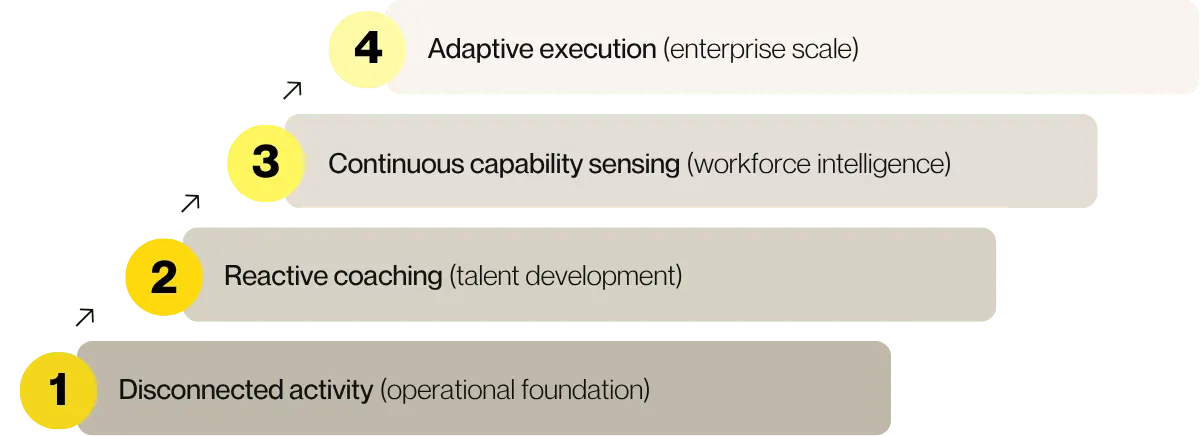
Stage 1: disconnected activity (operational foundation)
Current state: Mandatory training runs in a learning management system (LMS) while performance reviews live in a separate HR tool. Managers track course completions, but nobody tracks actual floor ability.
Next priority: Audit your data silos. Map a short list of core job skills instead of building a huge taxonomy.
Stage 2: reactive coaching (talent development)
Current state: Training links to job roles, but manager coaching is spotty. Skill chats only happen after mistakes or customer complaints occur.
Next priority: Give site managers a clear view of team skills. Track time-to-productivity instead of learning hours.
Stage 3: continuous capability sensing (workforce intelligence)
Current state: Shift data and floor feedback keep each worker’s skill and confidence levels up to date.
Next priority: Send real-time skill data to leaders before site launches, staffing shifts, or product rollouts.
Stage 4: adaptive execution (enterprise scale)
Current state: Skill gaps trigger quick coaching prompts for managers in real time. Teams adapt fast when company goals shift.
Next priority: Put workforce readiness metrics directly on C-suite dashboards next to revenue and profit metrics.
Ready to map your operational strategy?
Explore the complete guide to workforce enablement to align your learning, feedback, and performance metrics.

Beyond training: the 4Cs of workforce readiness
Measuring readiness only through training creates blind spots. A worker can pass a written safety test and still hesitate on the floor. A new rep can ace the product quiz and freeze on a live call.
Readiness has four parts: capability, confidence, consistency, and compliance. No single tool builds them. Learning, engagement, performance, and compliance work together to build readiness and keep it.
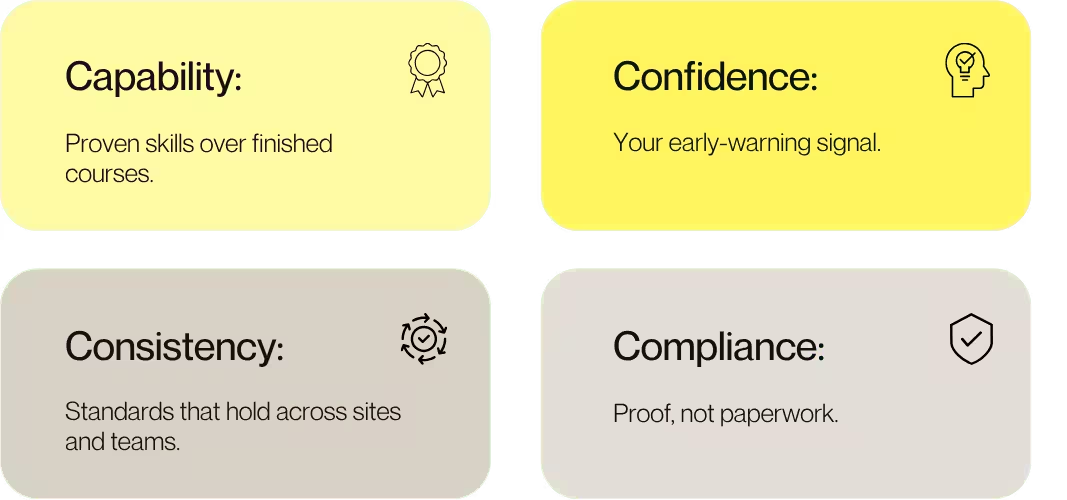
1. Capability: proven skills over finished courses
Capability measures whether employees can do the work, not whether they finished the course. Practical tests, manager reviews, and role-plays prove it. Video views do not.
On the frontline, that might mean operating equipment safely or following your returns policy during a rush. In a scale-up, it might mean a new rep handling objections in role-play before a live buyer call.
Learning builds the skill. Performance data shows whether it holds up in the work.
2. Confidence: your early-warning signal
Confidence measures whether employees feel ready to work without hesitation. It acts as an early warning sign. When task confidence drops, mistakes, complaints, and safety issues can follow.
Listen for friction and doubt. Launch a new tool or process and watch confidence scores fall? You have a readiness gap, even if everyone passed the quiz.
Picture a scale-up that rolls out new pricing. Reps pass the enablement quiz, but they hesitate in live pricing conversations. Engagement signals surface that doubt early, so managers can coach before deals stall.
3. Consistency: standards that hold across sites and teams
Consistency measures whether standards hold across every site, shift, team, and region. A top-performing main store means little if regional sites lag behind. A sales team is no different if reps ramp fast under one manager and slowly under another.
41%
of frontline leaders report significant or extreme performance variation between locations.
(The Frontline Enablement Gap)

To build consistency, cut decision delay. That’s the time it takes a manager to spot and fix a gap. When completion data, feedback, and performance results sit in separate tools, gaps stay hidden and hard to surface. Connecting them gives managers a clearer view and faster coaching.
4. Compliance: proof, not paperwork
Compliance measures whether people follow safety rules, laws, and company policies at work.
One error at one site could be an isolated mistake. The same error repeated across 30 sites points to a system-wide readiness gap. Scale-ups see the same pattern with data security or code of conduct training: a policy everyone signed, and a gap nobody noticed until an audit.
Compliance runs through everything above. Training delivers the requirement. Engagement signals show whether people understand it. Performance data shows whether it holds on the job. Systemic gaps can bring audit fines, safety hazards, and brand damage, so compliance needs daily proof.
Metrics that show workforce readiness
Readiness is the outcome you’re tracking, not a single number. The 4Cs tell you what good looks like. These metrics show whether you’re getting there.
| Activity metrics (what happened) | Readiness signals (what it means) |
|---|---|
| Course completion percentages | Task capability shown in practical tests and role-play |
| Total training hours logged | Time-to-productivity (ramp time to full output) |
| Yearly survey scores | Task confidence trends from shift feedback |
| Mandatory policy sign-offs | Compliance adherence confirmed on the floor |
To build a workforce readiness strategy around these signals, start with the metrics that match your biggest risk.
Using a skills gap analysis to spot risk early
Understanding the 4Cs helps leaders check team ability before big events. Whether opening a store, preparing for peak season, or hiring fast, a skills gap analysis spots risks before they hit your bottom line.
A performance drop is rarely just a training issue. To spot real risk, read three signals together:
- Can they do the work? Proven ability through tests or practice
- Do they feel ready? Real-time task confidence
- Are they delivering on shift? Actual work results
Compliance and safety risks start hurting team work at an average of 475 employees, but formal performance tools arrive at an average of 483 employees.
(The Scale-Up Enablement Gap)
This eight-employee gap shows a clear truth: performance risk arrives before the tools to manage it. To see how fast growth creates this gap, read How growth exposes the scale-up workforce enablement gap.
The perception gap audit
Before running a full gap review, run a perception gap audit. Compare how site managers rate team skills against how floor staff rate their own confidence. Any big gap between manager assumptions and staff confidence flags hidden risk, compliance issues, or turnover.

The 5-step operational gap review
- Define the business outcome you need. Start with the business metric you must move, like ramp time, site consistency, or error rates. Avoid starting with a list of courses.
- Identify key roles and locations. Find the exact stores, shifts, or teams where performance variation creates the highest risk.
- Study top-performer habits. Study your best teams. Record their daily habits and wording to build a practical training baseline.
- Audit ability, confidence, and output together. Check assessment results, confidence scores, and shift data together to see where work breaks down.
- Assign targeted floor actions. Fix the root cause. Separate knowledge gaps (needing clear guides), confidence dips (needing manager coaching), and process bugs (needing workflow fixes).
Beyond the work readiness questionnaire
In the past, companies used yearly surveys or paper questionnaires to check readiness. Asking staff how ready they feel gives basic feedback, but relying on surveys creates major blind spots.
A static survey only captures how a worker feels at one moment. It cannot prove if that worker can complete a procedure under shift pressure.
93%
of scale-up leaders report that onboarding is consistent across teams, yet 87% admit workers are still not fully equipped as headcount grows.
(The Scale-Up Enablement Gap)

A consistent process or completed survey does not guarantee real capability on the floor.
Solving the “So what?” and “Now what?” problems
Single-purpose tools trap leaders in two dead-ends:
- The “So what?” problem: A training tool shows an employee finished a module. Without feedback or shift metrics connected to it, leaders wonder: So what? Did that training change how they work on shift?
- The “Now what?” problem: A survey shows task confidence dropped at a regional store. Without skill data or manager coaching context attached, the site lead asks: Now what? Is this a training issue, a process bug, or manager burnout?
True readiness needs continuous capability sensing: reading learning, feedback, and performance signals together as work happens. That’s the practice to aim for, and most teams build toward it in stages.
Here’s what Confirm connects today.
For frontline:
Learn:Go and Engage bring learning and engagement signals together for frontline teams. Perform is available as a standalone capability, with deeper integration across the system planned.
What workforce readiness looks like in practice
To see how signal reading transforms work, compare how “trained” workers and “ready” workers perform under pressure.
Frontline multi-site operations
Scenario: A multi-site retail business preparing for a peak seasonal surge.
What "trained" looks like:
- 100% of seasonal staff completed the mandatory onboarding module on customer returns.
- L&D completion dashboards turn green before the rush.
- Store managers report that training targets are met.
What "ready" looks like:
- Store staff execute returns accurately during busy weekend rushes without manager help.
- Shift leads get quick coaching nudges when transaction error rates rise at a site.
- Task confidence scores match fast shift speeds across all stores.
What surfaces the gap earlier? Tracking shift-level confidence scores before peak season exposes staff who know process theory but lack confidence under pressure. This lets local managers run quick five-minute coaching loops before footfall hits.
To explore frontline challenges, read The uncomfortable truth about frontline workforce enablement and how to deliver workforce enablement without disrupting multi-site operations.
Scale-up growth organizations
Scenario: A fast-growing B2B company scaling its account executive teams.
What "trained" looks like:
- New sales reps finish product decks and pass product quizzes in week two.
- HR records show onboarding is complete.
- Reps get full sales quotas starting in month two.
What "ready" looks like:
- Reps handle complex sales objections accurately in role-play practice before buyer calls.
- Ramp time to first deal matches top-performer averages.
- Manager coaching targets specific confidence dips found during early sales calls.
What surfaces the gap earlier? Running role-play assessments during month one shows when reps struggle with pitch messaging, preventing long ramp times and missed quotas.
From diagnosing readiness gaps to building enablement
Spotting readiness gaps shows where your business faces risk. Closing those gaps and keeping performance high requires a connected operational system.
Readiness gives you the snapshot: are your people ready right now? Enablement is the daily practice that connects learning delivery, team feedback, and manager coaching into shift workflows.

Positioning a workforce enablement system (WES)
A workforce enablement system (WES) plays a different role from the systems that hire and administer your workforce.
- Applicant tracking systems (ATS): ATS software manages hiring to bring new talent in.
- Human capital management (HCM) / HRIS: HCM and HRIS software manage payroll, benefits, and employee records.
- Workforce enablement systems (WES): A WES connects learning, engagement, performance, and compliance to help people become, and stay, ready to perform.
Rather than simply managing workforce data, a WES helps turn that data into action. It connects the signals that show whether people are equipped, confident, compliant, and performing effectively. That helps organizations spot gaps earlier and take action in the flow of work.
A WES complements your existing ATS and HCM software. It provides the connective layer between learning, team sentiment, and shift performance, helping turn workforce readiness into sustained performance.
Next steps to strengthen your workforce readiness
A readiness check only matters if something happens next. You don’t need to fix everything at once. Start by finding out where you stand. Then build the routines that keep teams ready, and look at technology once the process is clear.
- Benchmark your team skills: Run a diagnostic review across your sites using our interactive assessment tool.
- Build an operational enablement plan: Move from one-off training events to daily coaching loops. Read how to build a workforce enablement strategy in 5 steps.
How to get there
Workforce readiness comes down to one question: can your people do the job well right now? The 4Cs give you a way to answer it. Capability shows what they can do, confidence shows what they feel able to do, consistency shows whether the standard holds from site to site and team to team, and compliance shows the risk you’re carrying.
A snapshot only takes you so far. Enablement makes it look good every time you take it by connecting learning, engagement, and performance, so a gap becomes a next step rather than another report.
That’s what Confirm’s workforce enablement system (WES) does. For frontline teams, it runs through Learn:Go, Engage, and Perform. For scale-ups organizations, it runs through Learn:Up, Perform, Academy, and Practice. Either way, you see where your people are ready, where they aren’t, and what to do about it.
See it in your business
Bring your toughest readiness question. Whether it’s a new site, a peak season, or a hiring surge, we’ll show you how a connected system answers it.

Frequently asked questions
What is the difference between workforce readiness and employee training?
Employee training is delivering courses, modules, or lessons. Workforce readiness is the operational metric that checks if an employee can perform job standards safely, competently, and confidently on shift. Training is one input, but true readiness also requires proven skills, active compliance, task confidence, and manager coaching.
How do you measure workforce readiness across multi-site frontline teams?
To measure frontline readiness, read three signals together across your stores: proven skill ability (via practical tests), shift-level task confidence (via quick mobile feedback), and shift outputs (like audit scores, error rates, and speed). Combining these signals gives site leads real-time visibility into risk before mistakes happen.
How does a skills gap analysis connect to workforce readiness?
A skills gap analysis acts as an early-warning tool in your readiness strategy. By comparing current staff skills and confidence against top-performer standards, a gap review highlights exact skill, confidence, or safety gaps before store launches, peak rushes, or product rollouts.
Why are static questionnaires insufficient for evaluating enterprise readiness?
Surveys only measure how a worker feels at one point in time. They offer self-reported sentiment rather than objective proof of ability. They cannot predict if a worker can execute procedures correctly under shift pressure. True readiness needs real-time sentiment paired with practical skill tests and shift performance data.
Does a workforce enablement system replace our existing HCM or LMS?
No. A workforce enablement system (WES) complements your current software. Your HCM handles payroll and employee records, while a traditional LMS delivers course catalogs. A WES links learning delivery, feedback signals, and performance metrics into shift workflows without replacing core HR administrative software.
Related resources
- The HRBP won’t survive the next decade whitepaper
- The complete guide to workforce enablement
- Workforce enablement: everything you need to know
- The talent flywheel: The end of learning in isolation
- 3 reasons the HRBP won’t survive the next decade
- Exposing the scale-up workforce enablement gap
- The uncomfortable truth about frontline workforce enablement
- The frontline enablement gap report
- The scale-up enablement gap report