
Your reviews closed on time. Your managers still don’t know what to do for the people who scored low.
Both can be true, and that gap sits at the center of the workforce enablement vs. performance management platforms question. A performance review score shows how someone was assessed. It doesn’t show why they fell short, or which learning and support would help them improve. The manager has the signal and no next step. That is the “now what?” problem.
Confirm’s research shows how common the pattern is. Among 400 frontline enterprises, 41% report significant or extreme performance variation between their best and worst locations. Leaders with a fully unified view of performance across sites are far more likely to hold steady at peak: 53% report very consistent performance, vs. 15% with only a partial view. Source: The Frontline Enablement Gap.
41%
of leaders report significant or extreme performance variation between their best and worst locations.
53%
report very consistent performance with a fully unified view across sites vs. 15% with only a partial view.
Workforce enablement is the practice of connecting learning, engagement, and performance so a workforce can do its job well. A workforce enablement system (WES) is the technology that runs it at scale, making people capable, ready, and effective after they’re hired. A performance management platform does one part of that job: it records and rates performance. Confirm sells performance capability too, as Perform, so we say plainly where it fits and where it doesn’t.
What a performance management platform is built for
A performance management platform gives your goal setting, review cycles, and feedback a structure. It does that job well, and HR teams depend on it.
These systems run the cycle. Managers and employees set goals that connect to organizational objectives, often using objectives and key results (OKRs). Managers collect feedback and write reviews. Many tools now support continuous performance management, with check-ins between formal reviews. The key features usually include:
- Goal setting and goal tracking, including OKRs
- Performance review cycles
- Continuous feedback and one-on-one meetings
- Calibration of ratings across teams
- AI-assisted review writing
Done well, this replaces the annual scramble with steady conversations between managers and employees. It gives HR teams a consistent record, clear visibility into goals, and performance data that supports continuous improvement. Many tools also tie results to development plans. Rating methods matter too, so see why HR needs to banish the bell curve. For measures beyond ratings, read employee performance metrics.
Used standalone, though, a performance management platform is designed primarily to record and rate performance. It can show that an employee missed their goals. It isn’t built to show whether they had the training, or how confident they feel. A low score tells a manager something is wrong. It doesn’t say whether the cause is a skill gap or a motivation gap.
What a WES adds
A workforce enablement system starts where the rating stops. It brings learning, engagement, and performance together, supported by content and AI, so you can equip people with the skills their role needs, listen for where they struggle, act with a clear next step, and measure whether performance moved.
Three signals make that possible. They form the Talent Flywheel: Learn → Engage → Perform. Learning equips people. Employee engagement shows where they struggle. Performance proves the business outcomes. Results then feed back into what gets trained next, and that loop is what makes continuous improvement possible.
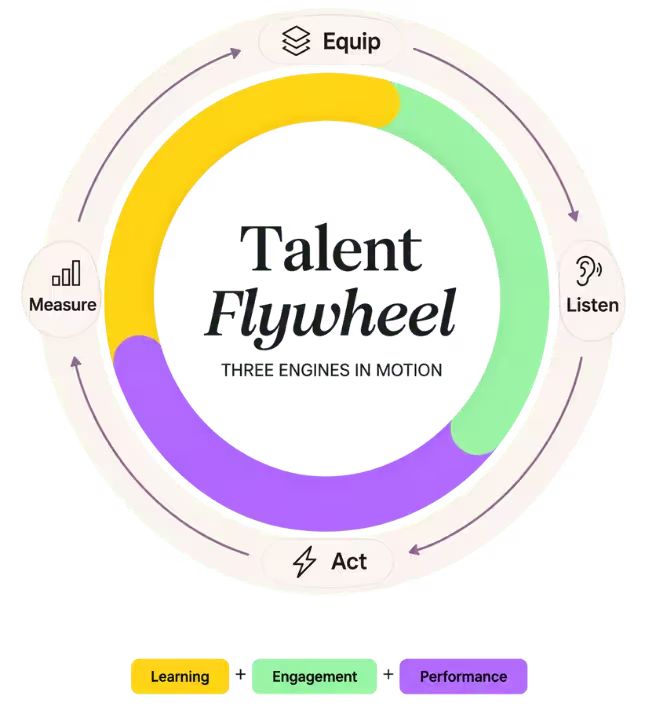
That makes this a mismatch, not a like-for-like comparison. A performance management platform is a point solution built for one job. A WES is the connected system, and a performance tool can sit inside it. Performance data becomes the proof point in a wider view of readiness, not a record that stands on its own. Connected signals also make it easier to see what your high-performing sites do differently, so you can build it into what everyone learns.
A WES focuses on how people become capable, ready, and effective once they are in the job. It sits alongside your existing HR technology. An applicant tracking system (ATS) hires people. A human capital management (HCM) or human resources information system (HRIS) administers them. A WES complements both.
Adam Thompson, Confirm’s CEO, argues that enablement should tie directly to a team’s own number. Read his argument. For a practical plan, see how to build a workforce enablement strategy.
| Strengths | Limits or what it adds | |
|---|---|---|
| Performance management platform | Mature, familiar, strong at goals, reviews, and a consistent record | Used standalone, no built-in view of learning or engagement |
| WES | Connects learning, engagement, and performance in one picture | Adds operational context and a next step when any signal dips |
Can one system combine performance reviews, employee engagement, and learning?
Yes, though how well the pieces connect depends on the vendor. A workforce enablement system exists to bring all three signals together. Some performance tools also add employee engagement or development modules. Ask every vendor how data moves between them.
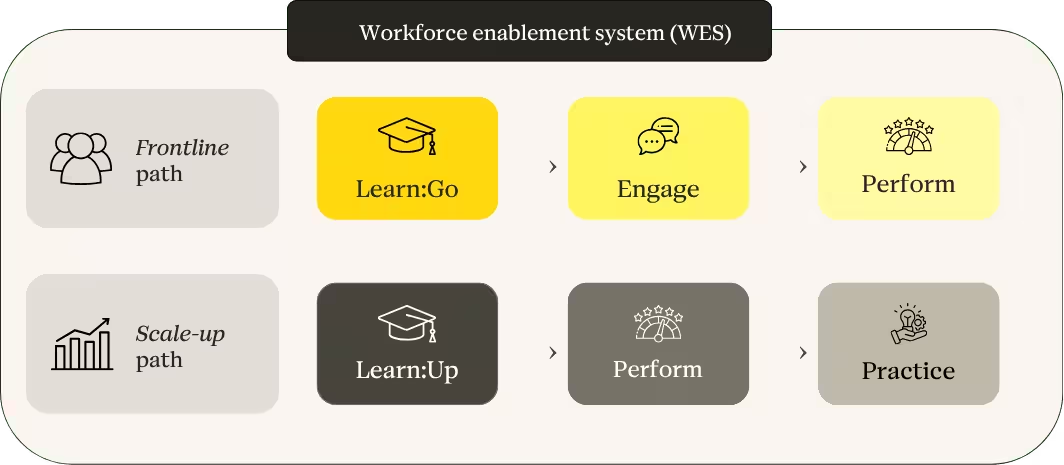
Confirm offers all three as modules of one workforce enablement system. Learn:Go or Learn:Up covers learning. Engage covers engagement for frontline teams, and for scale-ups, engagement is built into Perform. Perform covers performance. Buy one module or all of them.
- Frontline path: start with Learn:Go, then add Engage and Perform.
- Scale-up path: start with Learn:Up, then add Perform and Practice.
Performance management platform alternative or addition?
For most teams, it’s an addition. Keep your current tool if it runs your cycles well. Replace your performance management solution only if it no longer fits how you set goals and review people. If the problem is what happens after the rating, a second review tool won’t fix it. A connected system will.
Workforce enablement system vs. performance management platform: side by side
Most of the difference comes down to one thing: what a tool can do after it records a rating. The middle column shows Perform on its own, because starting with one module is a sensible way in.
| Performance management platform (standalone) | Perform on its own | Workforce enablement system | |
|---|---|---|---|
| What it is | Point solution | Point solution, and a module of a WES | The connected system |
| Core job | Set goals, run reviews, record ratings | Run AI-assisted performance cycles and show performance across teams and sites | Connect learning, engagement, and performance |
| What it measures | Goal progress, ratings, and feedback | Performance by person, team, and site | Capability, readiness, and performance, together |
| After a low rating | The manager decides what to do next, often without knowing the cause | The manager sees performance by person, team, and site, then decides | Learning and engagement context can point to a likely cause and next step |
| Manager burden | Writing reviews and chasing completion | Less time writing reviews with AI assistance | One view of who’s ready, without pulling three reports |
| Leaves you with | A rating and a “now what?” problem | A rating and a “now what?” problem | A proven outcome and a clear next step |
| Best fit when | Goal setting and a consistent review record are the whole problem | You want to fix your most urgent performance gap first | Learning, engagement, and performance all need to work as one |
Read along the “after a low rating” row and the pattern is clear. The more signals a tool connects, the less the manager is left to guess.
What this means for frontline and scale-up teams
Frontline teams feel the gap as inconsistency. Scale-ups feel it as lag.
Frontline teams
Shift workers don’t sit in review meetings at a desk, and managers may cover several sites, so review cycles built around desk time fit badly. Among 400 frontline enterprises, 76% say performance or training gaps often or very often create compliance risks or operational failures. And 46% cite lack of manager support as a barrier to effective training and performance. Source: The Frontline Enablement Gap.
Perform gives leaders data-driven visibility into performance across teams and sites. Learn:Go puts learning on a phone or shared device. Engage shows where confidence is slipping in real time, while you can still respond. For the full picture, read the uncomfortable truth about frontline workforce enablement.
Scale-up teams
Fast hiring outruns annual review cycles. In The Scale-Up Enablement Gap, 93% of leaders say growth is outpacing enablement (significantly or moderately), and new hires take 2.4 months on average to reach full productivity. Source: The Scale-Up Enablement Gap.
A review that lands months later can’t help a new hire who struggles in week three. Learn:Up gives onboarding a consistent structure as headcount climbs. Practice lets people rehearse realistic conversations with AI simulation. Perform uses Organizational Network Analysis (ONA) to help reveal and retain high-performing people, and gives leaders visibility into performance. See how growth exposes the scale-up workforce enablement gap.
76%
say performance often or very often creates compliance risks or operational failures.
46%
cite lack of manager support as a barrier to effective training and performance.
93%
say growth is outpacing enablement significantly or moderately.
2.4
months is the average time it takes for new hires to reach full productivity.
Best performance management platforms compared
Searching for the best performance management software or performance review software usually means comparing the same handful of names. Buyer guides sort them by type: goal and OKR specialists, check-in tools, engagement-plus-performance suites, and modules inside larger HR systems.
Two questions separate them. Beyond performance, does the product cover learning and engagement? And do those signals connect? The test is whether data flows between modules and gives the manager a next step.
| Option | Best for | Performance | Learning | Engagement |
|---|---|---|---|---|
| Perform | Frontline and scale-up teams | Core | Learn:Go or Learn:Up, modules of the same WES | Engage, a module of the same WES (built into Perform for scale-ups) |
| Lattice | Teams pairing reviews and goals with engagement | Core | Module (career development) | Module |
| Culture Amp | Performance grounded in engagement analytics | Module | Module (development plans) | Core |
| 15Five | Manager-led check-ins and feedback habits | Core | Module (manager training) | Module (surveys) |
| Betterworks | Goal alignment and calibration at scale | Core | Not a focus* | Module (surveys) |
| Workday | Large enterprises already on Workday HCM | Module of HCM | Module (skills and careers) | Separate product (Workday Peakon) |
*Not a focus means we found no dedicated product on the vendor pages we reviewed.
Perform
What is does
Supports AI-assisted performance cycles and gives leaders data-driven visibility into performance across teams and sites. For scale-ups, it uses ONA to help reveal and retain high-performing people.
Designed for
rontline enterprises with many sites and shifts, and fast-growing scale-ups.
Strengths
Buy it on its own or as part of the WES. Learn:Go or Learn:Up covers learning, Engage covers engagement, and Practice covers AI role play, all within the same workforce enablement system.
Limits
If deep OKR cascading or complex calibration is your priority, ask how Perform handles it.
Lattice
What is does
Runs reviews, one-on-ones, feedback, goals, and OKRs, with engagement surveys, career development, and compensation as further modules. Its AI drafts review write-ups from a manager’s own notes and feedback.
Designed for
Mid-size to large businesses, including hybrid and distributed teams.
Strengths
Goals roll into reviews and one-on-ones in one place. Reviewers praise its ease of use and the time AI saves on review writing.
Limits
It’s performance-first with modular add-ons, so check what each module includes and costs. Some reviewers mention limits in customizing templates and want more integrations.
Culture Amp
What is does
Offers reviews, 360 and upward feedback, OKRs, one-on-ones, and development plans beside its engagement surveys and benchmarks.
Designed for
HR teams that want engagement analytics next to performance, from mid-market to enterprise.
Strengths
It’s backed by survey science and benchmark data, and AI features help summarize feedback and improve review language.
Limits
Buyer guides describe it as stronger on measurement than on workflow. Pricing is quote-only, and reviewers mention admin complexity. We found no dedicated course delivery product.
15Five
What is does
Runs short weekly check-ins, one-on-ones, reviews (self, manager, and peer), OKRs, and 360 feedback, plus engagement surveys. It also sells manager training and coaching.
Designed for
People managers and HR teams that want to build feedback habits, typically in mid-market companies.
Strengths
Reviewers describe an easy start and a short learning curve for basic check-ins. The focus on manager effectiveness is clear.
Limits
Its value depends on managers reading and acting on check-ins. Reviewers mention check-in fatigue as features grow. It focuses on people processes, not core HR.
Betterworks
What is does
Centers on goals and OKRs, continuous check-ins and feedback, review cycles, and calibration. It adds AI assistance and a talent intelligence layer covering skills and succession.
Designed for
Mid-market and enterprise organizations with established HR processes.
Strengths
Calibration, OKR cascading, and the ability to sit on top of an existing HR system are its draw.
Limits
Reviewers describe calibration setup as admin-heavy for complex organizations. Smaller teams may not need this depth. Pricing is custom.
Workday
What is does
Its performance tools sit inside Workday HCM. They cover goals, reviews, calibration, talent reviews, and skills, with career and talent marketplace features alongside.
Designed for
Large organizations already running Workday HCM.
Strengths
Performance data lives with your system of record, next to skills and talent data. Managers can complete reviews on mobile.
Limits
It works best inside the Workday ecosystem, so check how it fits if your HR stack is mixed.
For the wider category, read the best workforce enablement systems in 2026.
5 questions to ask any performance management platform vendor
Ask any vendor, including us, what happens after a review flags a gap. If the answer covers only one signal, you’re looking at a point solution.
- What happens after a review flags a gap, and who acts on it?
- Can a manager see who is ready without pulling a report?
- How do review and goal data connect back to learning and engagement?
- What does the three-year cost look like once add-ons and renewals are included?
- Can I keep my existing review history if I switch?
If you are switching, plan for workflow disruption and a real adoption effort. Protect your review history, and time the move away from review cycles and seasonal peaks.
5 operational symptoms you may have outgrown your performance management platform
Run through these five. If more than one sounds familiar, your performance management process is probably doing its job, and the gap sits in what connects it to everyday performance.
Symptoms
- Your reviews close on time, yet performance still varies by location.
- Managers can't tell skill gaps from motivation gaps.
- Low performers get sent to generic training instead of targeted development plans.
- Review data never reaches training decisions.
- New hires take more than four weeks to reach full productivity.
A platform that works as designed isn’t built to see what happens around it. To track the signals that matter, see workforce enablement KPIs: 3 layers.
Choose a performance management platform, a WES, or both
The right choice depends on whether goal setting and reviews are the whole problem or only part of it.
- Choose a performance management platform if goal setting and a consistent review record are the whole problem.
- Choose a WES if learning, engagement, and performance all need to work as one, and managers need to know who’s ready without pulling three reports.
- Choose both if your current tool still does its job and you want to add learning and engagement alongside it.
The bottom line
A performance management platform records how someone performed. A WES shows whether support changed it. When you compare options, ask what happens after a review flags a gap, because that is where teams improve performance.
Ready to connect the dots?
Book a demo, or read the complete guide to workforce enablement to learn more.

Comparing other categories? See WES vs. LMS, WES vs. LXP, and WES vs. employee engagement platforms.
Common questions about WES vs. performance management platforms
Do we have to replace our current review tool?
No. Replace it only if it no longer fits how you set goals and review people. You can start with one WES module, such as learning or engagement, and keep the review tool you have.
Is a WES the same as talent management software?
No. A WES focuses on how people become capable, ready, and effective once they are in the job, by connecting learning, engagement, and performance.
Do we have to buy every WES module at once?
No. Start with your most urgent bottleneck, then add learning, engagement, and performance as your strategy matures.
Related reading
- The complete guide to workforce enablement
- The 12 best workforce enablement systems and platforms in 2026
- Workforce enablement – everything you need to know
- Bell curve performance reviews: What they are, how they work, and why HR is moving on
- Employee performance metrics: 50+ KPI examples by role (2026)
- WES vs. LMS: what’s actually different
- WES vs. LXP: why content discovery isn’t job readiness
- WES vs. employee engagement platforms
- The Frontline Enablement Gap report
- The Scale-Up Enablement Gap report
- The talent flywheel: The end of learning in isolation
- How to build a workforce enablement strategy (5 steps)
- The uncomfortable truth about frontline workforce enablement
- Exposing the scale-up workforce enablement gap
- Workforce enablement KPIs: 3 layers that show real impact